Event 1
French Revolution
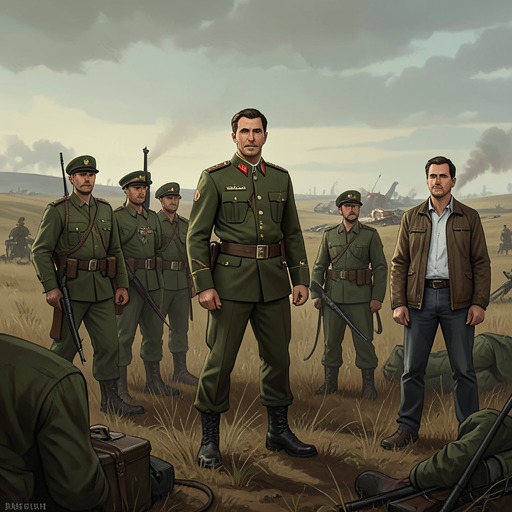
The [French Revolution](entity:event-recall-event-75c495bcf362) appears in the narrator’s historical argument as a turning point in the organization of warfare: political emancipation and popular participation become, in his telling, means of producing citizen-soldiers. By linking literacy, voting, patriotic enthusiasm, and enlistment to mass death, he challenges the belief that national ideals make war noble or voluntary sacrifice free of coercion.
## From emancipation to mobilization
The narrator compresses the revolutionary sequence into a brisk chain of causes. The people are first taught to read newspapers, an education presented as the road to salvation; they become citizens who vote, read, fight, march, and send messages from the front. This expanding participation is not treated as a simple political achievement. The same enthusiasm associated with liberation, he argues, is redirected toward military service, preparing the population for a new kind of mass army.
He connects that transformation to the rhetoric and organization of revolutionary leaders, naming Danton’s stirring phrases and Dumouriez’s role in leading battalions into [Flanders](entity:location-recall-location-3ff0009360ef). The people who march are described as newly emancipated, yet their destination is the battlefield. In this telling, civic inclusion and military mobilization develop together: the citizen’s new political identity also makes him available for national warfare.
## The citizen-soldier and the price of patriotism
The [Battle of Valmy](entity:event-recall-event-daf851d929f9) gives the argument a defining scene. Goethe, arriving there, is said to have been astonished by ragged, impassioned troops who had come of their own free will to fight the King of Prussia for a patriotic fiction. His famous declaration that the day began a new era becomes, in the narrator’s account, an ironic marker of historical change: the novelty lies not only in the battle but in a political system capable of generating mass sacrifice through patriotic belief.
The narrator contrasts the free-gratis soldier with the mercenary tradition, presenting Dumouriez as the last mercenary before this new military arrangement took hold. Dumouriez himself, he says, deserted after discovering that money interested him more than the new idealistic pursuits. The contrast exposes the narrator’s central suspicion: the appearance of willing, patriotic service does not erase the costs borne by the people who fight. It changes the language through which those costs are justified.
## The Revolution as a precedent for modern war
The revolutionary history is not an isolated digression. It enlarges the narrator’s contemporary experience of war into a critique of patriotic mobilization across time. Earlier, he imagines workers trapped below deck, laboring while their masters enjoy the open air, only to be summoned into battle by leaders who promise a fight against an enemy. In his later reflections, the history of the French Revolution supplies a precedent for how popular participation can be turned into collective military action.
That argument becomes personal when the narrator describes his arrival at the front as an initiation into horror and a mass flight into collective murder. Later, hospitalized and placed under observation because his patriotism is considered impaired or dangerously sick, he sees military and administrative institutions treating him as a problem to be managed. The revolutionary ideal of the citizen-soldier thus stands in sharp contrast to his experience of being counted, watched, and expected to return to the front.
## Patriotism and the narrator’s dissent
In a conversation with [Professor Bestombes](entity:character-recall-character-professor-bestombes-5a218c921b05), patriotism is identified as the highest concept for awakening altruism, while glory is presented as its proof. The professor argues that soldiers at their first baptism of fire abandon self-preservation and merge with the nation’s purpose. Set beside the narrator’s account of the revolutionary citizen-soldier, this doctrine makes the historical continuity clear: patriotic language casts participation in war as moral elevation and can recast self-preservation as a defect.
The narrator’s account refuses that conversion. His image of the battlefield as a place where supposedly free citizens are sent to die, and his memory of the front as collective violence, undermine the claim that patriotic sacrifice is inherently noble. The French Revolution matters to the entry not as a neutral chronology of political events but as the historical precedent through which he examines how emancipation, national belonging, and mass warfare can become bound together.
Event 2
Battle of Valmy
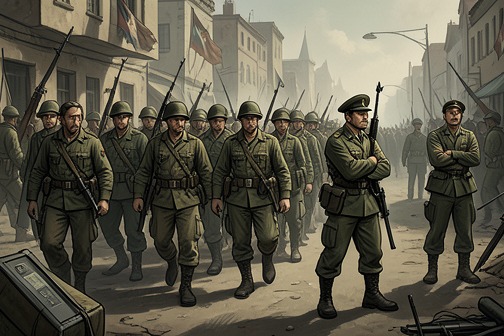
The [Battle of Valmy](entity:event-recall-event-daf851d929f9) is presented not as a military chronicle but as a precedent in the history of patriotic mobilization. In [Ferdinand Bardamu](entity:character-recall-character-ferdinand-bardamu-9de4af40bdf1)’s bitter recollection, its significance lies in the transformation of voluntary national service into a system for producing soldiers and heroes at mass scale—a transformation that exposes the human cost concealed by the language of emancipation and glory.
## A remembered turning point
[Bardamu](entity:character-recall-character-bardamu-9eb69ea71af7) invokes Valmy while reflecting on how revolutionary ideals became instruments of military recruitment. He describes people first being taught to read newspapers and encouraged to become citizens who vote, fight, march, and send messages from the front. In this telling, political participation and literacy are folded into a program of mobilization: the newly emancipated public becomes ready for battle.
The recollection places Valmy within a wider sequence rather than isolating it as a battlefield episode. Bardamu contrasts Dumouriez, who deserts after discovering that money interests him more than these new idealistic pursuits, with the soldiers who go willingly to war. Dumouriez is called the last mercenary; the free soldier, by contrast, represents something new.
## Voluntary sacrifice and patriotic fiction
The decisive image of the Battle of Valmy is a body of ragged, impassioned soldiers who have come of their own free will to fight the King of Prussia in defense of what Bardamu calls a patriotic fiction. Goethe, arriving at Valmy, is said to recognize that this marks the beginning of a new era. The point of the episode is not a tactical result but a change in how war can be justified: sacrifice for the nation is presented as a voluntary ideal rather than merely a paid service.
Bardamu’s retrospective account makes that voluntariness unsettling. The soldiers’ commitment allows the system to mass-produce heroes, eventually at almost no cost. The heroic ideal thus appears less as a spontaneous expression of freedom than as an efficient means of securing lives for the state’s purposes. Valmy becomes an origin story for a political order in which patriotic belief can make mass sacrifice appear willing and honorable.
## The later war and the critique of heroism
The recollection gains force from Bardamu’s own experience of war. At the front, he sees military leaders continue their work amid lethal danger and recognizes that the conflict is sustained by people who cannot conceive of their own deaths. His fear turns into panic at the prospect of millions of men absorbed in collective killing. He describes this as his first true encounter with war: not an abstract national cause, but a system of violence that has become intimate and inescapable.
That experience shadows the lesson he draws from Valmy. In a hospital for wounded soldiers whose patriotism is considered impaired or dangerously ill, officials attempt to make patients confess, while the ordinary paperwork and precautions mark them as men being counted and prepared for a return to the front. A medical authority presents patriotism and glory as the highest moral concepts, arguing that soldiers in battle cast aside self-preservation and merge with the nation. The claim clarifies the institutional logic implicit in Bardamu’s account of Valmy: the ideal soldier is one whose instinct to survive has been reclassified as a defect.
## Narrative significance
Valmy is a historical reference recast as an argument about the manufacture of consent. Bardamu’s account moves from literacy and citizenship to voluntary enlistment, then from the free soldier to the mass-produced hero. Its irony lies in describing the result as a successful system: what looks like emancipation supplies the state with people willing to risk their lives for a patriotic abstraction.
The episode also belongs to the novel’s larger contrast between official descriptions of war and the narrator’s experience of fear, injury, surveillance, and institutional pressure. Bardamu does not offer a neutral account of the battle; he uses the memory of Valmy to challenge the language through which sacrifice is made glorious. Its decisive significance is therefore ideological: it marks, in his telling, the emergence of a modern form of patriotic mobilization whose triumph is measured by how readily ordinary people can be made into heroes.
Event 3
Bardamu’s confrontation with Captain Frémizon
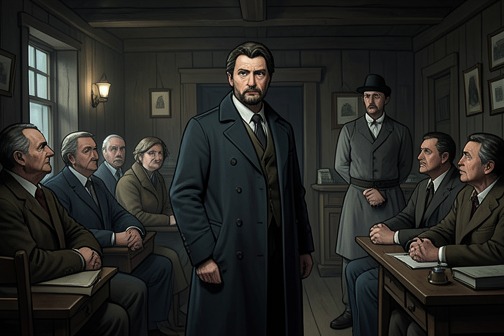
[Bardamu’s confrontation with Captain Frémizon](entity:event-recall-event-bardamu-s-confrontation-31ce44c92f63) is a near-violent reckoning aboard the Admiral Bragueton in which [Bardamu](entity:character-recall-character-bardamu-9eb69ea71af7) escapes punishment by turning accusation into theater. Faced with an officer demanding that he answer for supposedly insulting the colonial passengers, he denies the charge, performs extravagant patriotism, and finally leads his would-be attackers to drink. The immediate danger passes, but the reconciliation remains a fragile performance built on vanity, fear, and the need to survive.
## Causes and Background
During the ship’s passage toward [Bragamance](entity:location-recall-location-ee7820449f5f), Bardamu has withdrawn from the other passengers. He avoids meals and the deck, stops talking, and tries to make himself almost invisible. His cabin steward, a family man, tells him that colonial officers have sworn to slap his face at the first opportunity and throw him overboard. The steward cannot explain what provoked the threat; Bardamu, too, is left without a clear account of what he has done. The hostility appears to have gathered around his face and his silent presence rather than any stated grievance.
The threat takes shape in the enclosed social world of the ship. The officers and passengers have been confined together for weeks, with little to occupy them, and Bardamu observes that ordinary impatience and resentment become more conspicuous at sea. His rare appearances at table acquire the scale of public events: the passengers notice and whisper when he enters. By the time Captain Frémizon confronts him, Bardamu understands that the officers have been brooding over remarks they believe he has made since Marseille, while he has been trying to avoid them rather than challenge them openly.
## The Confrontation
Captain Frémizon arrives with four junior officers blocking the doorway. His formal address identifies him as captain of the colonial army and demands an explanation on behalf of his comrades and the ship’s indignant passengers. He accuses Bardamu of making intolerable remarks about them during the voyage and insists that he say openly what he has supposedly been saying in an undertone for twenty-one days. The scene’s ceremonial language leaves little doubt about the danger: Bardamu sees the officer as the embodiment of war, and his escort as the agents of an approaching execution.
Bardamu is relieved that Frémizon is speaking rather than striking. A demand for words, however threatening, gives him an opening to escape. He answers with vehement denials and professes that it is monstrous to suspect him of such contempt. He claims to have fought for [France](entity:location-recall-location-4f282e1af8a7) and to have shed his blood alongside the officers, then praises them as heroes preparing to resume their sacred duty in the colonial empire. His speech does not establish what he truly thinks of them; it is a calculated answer to the danger in front of him.
At a pause, Bardamu goes straight to the captain and takes both his hands. Keeping them enclosed, he continues his apology and attributes the apparent insult to his own timidity, which he says may have looked like disdain. He praises the assembled passengers, officers, and women, and asks to be admitted to their patriotic brotherhood. The physical gesture and the torrent of compliments work together: while holding Frémizon’s hands, Bardamu keeps the encounter from turning into a beating and gives the captain an awkward problem to resolve without violence.
## A Reconciliation Made of Performance
Bardamu’s address culminates in a patriotic appeal. He raises one arm while retaining the captain’s other hand and cries, “Vive la France! Vive la France!” The slogan creates a moment’s hesitation: the officers may be hostile, but striking a civilian who has just shouted for France is difficult. Bardamu treats that hesitation as the opening it is, reaching into the group to take two officers by the arms and inviting everyone to the bar for a drink in honor of his health and their reconciliation.
The officers resist only briefly. Soon they are drinking together for two hours, while the women look on in silence and apparent disappointment. Through the bar’s portholes, Bardamu sees the schoolteacher-pianist prowling with other women; he suspects that they recognize his escape as a trick and will try to catch him at another turn. The men’s agreement is therefore neither universal nor secure. Bardamu has escaped the immediate threat, not erased the suspicion that produced it.
To keep the peace, Bardamu listens to the officers’ stories of colonial exploits and responds with admiration. He asks for more accounts of their military deeds, finding that the soldiers are ready to provide them. His role is to seem impressed, not to test the stories. Praise lets the officers enjoy their own importance and gives Bardamu a way to remain inside the group without renewing the argument. By the end of the episode they decide he is acceptable, but that acceptance rests on a performance he must continue to sustain.
## Significance and Aftermath
The confrontation establishes self-preservation as Bardamu’s immediate priority. He does not defend himself by proving that the accusation is false or by appealing to justice; he seizes the chance offered by the captain’s demand for an explanation and supplies whatever words may keep him alive. His flattery, handclasp, patriotic cry, and invitation to drink are successive means of managing the threat. The episode’s turn is from near-certain violence to temporary safety, achieved not through courage but through a willingness to abandon self-respect when necessary.
That compromise changes Bardamu’s understanding of fear. The narrator later describes his self-respect draining away during the ordeal and says that, afterward, he felt morally lighter and freer. He presents fear as the means that got him out of danger and as a weapon he no longer needed to supplement with other virtues. The scene thus makes cowardice more than a humiliating lapse: it becomes a survival method, though one that requires Bardamu to play the admirer of men he had previously tried to avoid.
The shipboard reconciliation also exposes the instability of colonial solidarity. The officers invoke their comrades, their passengers, and the empire, but Bardamu gains their favor by flattering their vanity and inviting them to tell stories. Their apparent brotherhood can be restored by praise and drink, even though the women remain suspicious and the underlying grievance is never clarified. The incident ends with Bardamu temporarily included, not with the hostility explained or resolved; his safety depends on reading the group’s pride and performing the part it will accept.
Event 4
Bardamu’s escape from the Admiral Bragueton
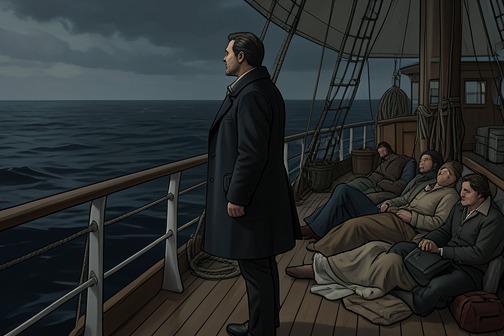
[Bardamu’s escape from the Admiral Bragueton](entity:event-recall-event-27520305009b) is a narrow passage from one form of confinement into another. When the ship anchors near the coast, he slips away in darkness with a few secretly prepared bundles and reaches land at Bambola-[Fort-Gono](entity:location-recall-location-00fa5447385f). The immediate prize is freedom from the vessel and its sleeping passengers; the shore reveals a colony whose hierarchy, exploitation, and malaria-ridden antagonisms offer no refuge from human cruelty.
## The opening in the ship’s vigil
The chance to escape comes during a lull. The Admiral Bragueton has slowed almost to a standstill, with no breeze and the sea seeming as sluggish as molasses. [Bardamu](entity:character-recall-character-bardamu-9eb69ea71af7) wants to return to the night, but the prospect of escape alarms him even as he watches for an opportunity. The conversation around him drifts from military anecdotes to ribald and filthy talk, then dwindles into incoherence. One by one, the company falls asleep. Their heavy, rasping snores turn the ship’s temporary quiet into a practical opening: for the first time, the men who have kept Bardamu among them are not watching him.
The ship is anchored a short distance from the coast, where only moving lanterns can be seen. Then roughly a hundred canoes crowd around it, their occupants calling out and offering their services. Bardamu has already wrapped up a few bundles in secret. He carries them to the gangway and slips down behind a boatman whose face and movements are almost lost in the darkness. The departure depends on anonymity and speed: the boatman is not a named ally, and the scene offers no elaborate plan, only a dark stairway, a waiting canoe, and the momentary disorder created by the gathering boats.
At the foot of the gangway, level with the splashing water, Bardamu asks where they are going. The answer is Bambola-Fort-Gono. Once the canoe pushes off, he helps paddle to make it move faster. From the water he takes one last look back at the ship. In the cabin light, the passengers lie bloated and sprawling, laid low by apathy and gastritis; officers, civil servants, engineers, and traders have become nearly indistinguishable in sleep. Their apparent ranks and occupations collapse into a single grotesque likeness. Bardamu’s escape therefore also changes the view from which the passengers can be judged: he is no longer enclosed among them, and can see their shared physical degradation from outside.
## Arrival at Bambola-Fort-Gono
A few moments after leaving the ship, Bardamu is back on land. The trees deepen the darkness, and silence seems to surround the shore. The landing is brief, but it marks a decisive change in circumstance: the immediate confinement of the ship has ended, and Bardamu has crossed into the colony without the authority or protection of its officials. His bundles have come with him; the account gives no further inventory, destination, or plan for them.
That first impression of freedom is immediately complicated by the colony’s organization. Its Governor rules triumphantly over everyone, and the soldiers and civil servants scarcely dare breathe when he turns his gaze toward them. Authority is concentrated at the top, while the officials beneath it are reduced to caution and submission. Bardamu has escaped the ship, but the land he reaches is not presented as an open or welcoming space: it, too, is structured by power.
## Colonial hierarchy and mutual hostility
Below the colony’s notables, resident traders prosper by stealing more readily than they could in Europe. The narration describes their reach in the smallest commodities: not a coconut or a peanut escapes their brigandage. Civil servants, worn down by fatigue and ill health, gradually recognize what their appointment has brought them: braid and forms to fill out, but very little pay. Their resentment turns toward the traders, whose profits expose the officials’ own poor return. The military faction occupies another compromised position. Less perceptive than either administration or traders, its members subsist on colonial glory, quinine, and red tape.
The colony’s physical conditions shape its social life. Everyone waits for the thermometer to fall; heat, thirst, and malaria drain what energy remains. The resulting quarrels are not confined to a single rivalry. They persist between soldiers and administrators, administrators and traders, temporary alliances against the military, and the whole colonial population and the black population; hostility also exists among black people themselves. The pattern broadens from disputes among competing colonial factions into a general condition of antagonism. The narrator presents the colonials as capable of dying from their own hatred, like scorpions poisoned by themselves.
## Escape without refuge
The escape’s structure is a sharp reversal, not a homecoming. A pause in the ship’s movement and the passengers’ sleep let Bardamu cross a threshold, but arrival does not resolve the danger or give him a secure place. He exchanges the ship’s enclosed company for a colonial settlement dominated by a Governor, predatory commerce, bureaucratic disappointment, military vanity, disease, and pervasive quarrels. The freedom gained is real in its immediate, physical sense—Bardamu has left the vessel and reached land—but it offers no escape from the exploitative relations and bodily hardship that define the next setting.
The episode also links personal evasion to a wider social diagnosis. Bardamu’s exit depends on the brief failure of the ship’s human vigilance; the colony’s violence, by contrast, is continuous and dispersed through its hierarchy, economy, climate, and rivalries. Night first conceals his flight, then surrounds his landing with silence, but darkness does not erase what governs the place. The escape carries him out of one vessel and into a colony where the struggle for advantage and the damage done by heat, illness, and hatred have already become ordinary conditions of life.
Event 5
Bardamu’s assignment to the Bikomimbo trading post
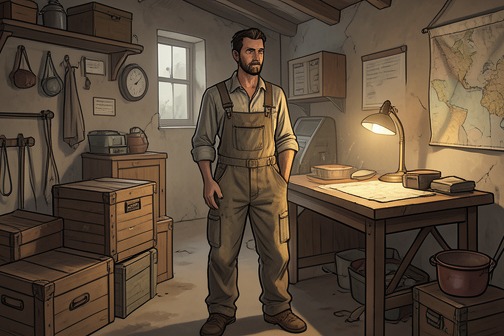
[Bardamu’s assignment to the Bikomimbo trading post](entity:event-recall-event-07eb04879205) turns an employment offer into a passage through two systems of exploitation. Hired as an inexperienced replacement by the [Director](entity:character-recall-character-compagnie-porduri-r-b7f8eb57948f) of the [Compagnie Pordurière](entity:organization-recall-organization-compagnie-pordur-b5056a590d6b), he is sent from the colonial headquarters toward an isolated post; the journey reveals the Company’s demands, the precariousness of colonial infrastructure, and the labor practices that sustain its trade. Later, [Bardamu](entity:character-recall-character-bardamu-9eb69ea71af7)’s experience at the [Ford factory](entity:location-recall-location-f2f56a95c5af) repeats the assignment’s central lesson in another setting: the institution values obedience and output, not independent thought.
## Recruitment and the Company’s Terms
The Director of the Compagnie Pordurière is seeking an inexperienced man to take charge of a trading post in the bush, and Bardamu promptly offers his services, describing them as incompetent but enthusiastic. The Director questions him about his past and notices that he has studied medicine. Bardamu’s education is treated not as a qualification in its own right but as something that might come in handy in the colony. The Director also tests his habits by offering him whisky and a cigarette. When Bardamu declines both, the Director becomes suspicious, revealing a workplace culture in which personal habits are assessed through crude assumptions about an employee’s reliability.
The Director tells Bardamu that he is being sent to [Bikomimbo](entity:location-recall-location-d35ee309d1e0) to replace a man he dismisses as a joker. His account of the absent employee makes the Company’s priorities plain: the man has failed to send accounts and claims to be sick, but the Director insists that the Company comes first. Bardamu’s essential task, he says, will be to take inventory. The post has food for three months and merchandise for at least a year, but the warning is not reassuring: the Director tells him not to travel at night, advises him to bring his own quinine, and speculates that the outgoing employee might tamper with the supply. The instructions combine routine commercial oversight with suspicion and risk, as if an employee sent to safeguard the Company’s goods must also expect danger from the people and conditions around him.
## The Route to the Interior
The Director describes a journey of ten days: first by sea, then upriver. The route begins aboard the Papaoutah, a small, wood-burning, flat-bottomed freighter built for estuaries. Bardamu is the only white passenger and is given a cramped place between the kitchen and the toilet. The vessel moves so slowly along the coast that the journey becomes an ordeal of waiting rather than a rapid transfer to the post. Its approach to the destination is measured against the punishing colonial climate and the isolation that the Director had already invoked.
At [Topo](entity:location-recall-location-124c642bbf5a), the port of departure for the next leg, the Papaoutah finally pulls up after a prolonged passage. Three large thatched huts stand near the river mouth, and Bardamu is told that he will travel by canoe up the sandy river toward the jungle. The settlement’s bamboo dock has to be rebuilt every month because small mollusks eat it away; the freighter itself calls only once a month. These details make the route’s fragility concrete. The Company’s distant outposts depend on infrastructure that is perpetually being consumed or repaired, and even the arrival of a supply ship is an infrequent event.
The final approach takes Bardamu through ten days on the river and then along a hidden path into the forest. The canoe journey passes muddy whirlpools and drifting branches. After leaving it, the travelers move through dense vegetation, detouring around fallen trees before climbing to a rise that overlooks the forest. The path eventually leads into another valley, where the man Bardamu has come to replace is waiting in a hut built between two boulders. The hut is so ramshackle that it seems almost theoretical, a fitting first view of the remote post and of the precarious life attached to the Company’s outlying operations.
## The Labor Behind the Trade
Before taking to the bush, Bardamu learns to number sacks in the Company’s main warehouse. The work puts him among clerks and local laborers in a crowded, stifling space. Overseers’ clubs descend on the workers, who continue their labor without protest. The scene presents the colonial trade not as an exchange between equals but as a system in which the Company’s goods are counted and weighed through disciplined, unequal labor. The Director checks that Bardamu is learning both the sack-numbering techniques and the falsification of weights, making manipulation part of the commercial practice he is expected to master.
The Director explains his version of the Company’s achievement by contrasting the past he claims to remember with the present he has helped impose. He says that when he came to Little Togo, local people lived by hunting, fishing, and intertribal conflict; now, he boasts, they form a labor force producing peanuts and rubber. He describes the suppression of tribal life as progress, but immediately connects that transformation to taxes and the production of goods for the Company. His account exposes the material purpose beneath the rhetoric: labor and taxation have replaced the forms of life he condemns because they make extraction more dependable.
## A Repeated Discipline
The assignment’s logic returns in a different industrial setting when Bardamu seeks work at the Ford factory. There, an authority figure tells him that his medical studies will do him no good: he is not there to think but to perform the movements he is instructed to make. The factory requires workers who follow orders, and Bardamu is warned against mentioning his intelligence. His passage into the machinery is described as a change in which workers themselves seem to become machines, their attention and bodies absorbed by the continuous noise and motion of production.
Bardamu’s first factory task is to pass linchpins to a blind worker who has calibrated them for years. He performs badly, and after three days is transferred to pushing a trolley of washers from machine to machine. He leaves different numbers at different stations; nobody speaks to him. The sequence gives practical form to the earlier Company assignment: in both settings, an institution assigns a task, measures the worker by service to production, and leaves little room for thought or initiative. The colonial warehouse and the factory are not identical, but the parallel sharpens the episode’s account of labor as a discipline that makes people interchangeable.
## Significance of the Assignment
The Bikomimbo posting is both a job and a forced education in the workings of colonial commerce. Bardamu is hired to replace a supposedly dishonest or unreliable employee, told to safeguard the Company’s inventory, and sent along an arduous route to a settlement whose dock is regularly destroyed and rebuilt. Before he even reaches the remote post, he has seen the warehouse practices and labor relations that support the enterprise. The journey carries him away from the relative familiarity of the coast toward an increasingly isolated workplace, while the Director’s instructions make clear that commercial responsibility matters more to the Company than the employee’s health or comfort.
Read beside Bardamu’s later employment in [Detroit](entity:location-recall-location-67107b1c9592), the assignment also establishes a recurring structure in his working life: institutions welcome him as a useful pair of hands while discounting his education and judgment. In the colony, the Director’s priorities are accounts, inventory, merchandise, and production; at Ford, the worker’s prescribed movements take the place of independent thought. The different landscapes lead to a closely related loss of agency, making the journey toward Bikomimbo an early instance of the book’s wider association between employment and subordination.
Event 6
Bardamu learns that Alcide supports his niece Ginette
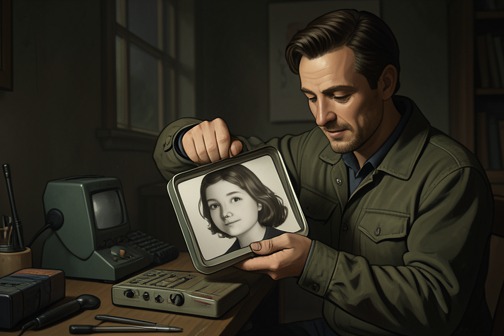
[Bardamu learns that Alcide supports his niece Ginette](entity:event-recall-event-619c8b517bd4) when a glimpse of a photograph in a small biscuit tin opens onto a private history of bereavement, responsibility, and sacrifice. [Alcide](entity:character-recall-character-alcide-ee06c6e80e58) is not saving money for the return home [Bardamu](entity:character-recall-character-bardamu-9eb69ea71af7) jokingly imagines: he is staying in [Topo](entity:location-recall-location-124c642bbf5a), far from the child he is raising at a distance, because his earnings and small business help provide for her. The disclosure transforms Bardamu’s view of a man he had once kept at arm’s length, revealing a tenderness that Alcide neither advertises nor asks others to repay.
## The Photograph and the Disclosure
During the long stretches of routine in Topo, Bardamu teases Alcide about the money he seems to be putting aside. Over canned tomatoes, he invents extravagant stories about how Alcide will spend it when he returns to Bordeaux. The jokes are a way of filling the station’s dullness, but they rest on Bardamu’s mistaken assumption that Alcide’s savings are for himself.
When Bardamu asks to borrow writing materials, Alcide’s small biscuit tin becomes the turning point. Alcide first moves to stop him opening it, then relents. A photograph of a little girl is pasted inside the lid. Bardamu closes the tin quickly, embarrassed by the accidental intrusion, and initially supposes the child may be Alcide’s own. Alcide explains that she is his brother’s daughter: both of her parents are dead, and his mother, who might otherwise have cared for her, is dead as well. Asked who is bringing her up, Alcide answers that he is.
## Ginette’s Care and Education
Alcide has arranged for Ginette to be raised in Bordeaux by the Sisters, whom he describes as a high-class school rather than a charitable institution. He stresses that she is his responsibility and will want for nothing. She writes to him and, he says, is making good progress; her schooling is expensive, and he also wants her to have piano lessons and learn English. His attention to these particular opportunities makes clear that support means more than keeping her fed: he is trying to secure an education and a future for a child he can scarcely see.
Alcide also tells Bardamu that Ginette had infantile paralysis two years earlier. Her left leg is atrophied, and a specialist in Bordeaux is treating her with electricity. Alcide asks whether Bardamu thinks she will recover the use of it. The question brings the child’s physical condition into the conversation without reducing her to it: she is present in Alcide’s life through letters and a photograph, but also through his practical efforts to pay for her schooling and specialist care.
## A Commitment Measured in Years
Alcide does not expect to visit Ginette soon. He says he may be unable to go for another three years because his small business in Topo helps support her; if he takes leave, someone else could take his post before he returns. He has therefore asked to serve a double hitch, remaining in Topo for six consecutive years instead of three. The decision makes his devotion concrete in time: the money for Ginette is earned through continued absence from her.
His concern extends beyond tuition and treatment. Alcide worries that Ginette has nobody to be with during the holidays, and says that this is hard on a little girl. His account reveals a relationship sustained by responsibility despite distance, with only letters and the photograph standing in for the daily presence he cannot provide. The limited means and precarious position described in the episode make his choice costly: leaving could mean losing the post on which his support depends.
## Bardamu’s Reassessment and the Episode’s Meaning
Bardamu’s response is not admiration at a distance but a sharp revision of his own conduct. He recalls having teased Alcide, kept him at a distance, and looked down on him. Now Alcide’s modest appearance and awkward embarrassment seem at odds with the tenderness and generosity his actions disclose. Bardamu judges the man’s heart superior to his own and feels unable to answer him; the confidences leave him ashamed of his former vanity and dismissiveness.
The narration emphasizes that Alcide does not present his sacrifice as a virtue. He blushes as though taking responsibility for Ginette were something indecent, and speaks of her care as an explanation rather than a claim to praise. Bardamu, looking at him asleep, sees an ordinary face and wonders whether there should be some mark by which good people can be distinguished from bad. The question underscores the episode’s moral contrast: goodness is difficult to recognize from outward appearance, and here it emerges through years of unadvertised work rather than declarations.
That quiet generosity stands against the colonial station’s grinding routine and the broader circumstances that keep Alcide from his family. The revelation does not undo those conditions, but it changes what Bardamu can see within them. A man whom he had treated as a target for jokes is revealed as someone using his scant resources and extended service to give a bereaved child tenderness and opportunity. The episode’s decisive turn is therefore also a correction in the narrator’s judgment: Alcide’s apparent dullness conceals a form of care that Bardamu recognizes as beyond his own.
Event 7
Robinson leaves the Bikomimbo post

[Robinson leaves the Bikomimbo post](entity:event-recall-event-dee0d6e26d75) rather than endure another stretch of isolated life in the forest, and his departure abruptly transfers its material and emotional costs to [Ferdinand Bardamu](entity:character-recall-character-ferdinand-bardamu-9de4af40bdf1). [Bardamu](entity:character-recall-character-bardamu-9eb69ea71af7) recognizes his companion as the same [Robinson](entity:character-recall-character-robinson-29744adcf921) he had known in wartime [Flanders](entity:location-recall-location-3ff0009360ef) and [Paris](entity:location-recall-location-paris-c02b439ce220), but the recognition comes too late to make their shared past a safeguard: by morning Robinson has vanished, taking almost everything the fragile trading post contained. The episode turns an uncanny reunion into abandonment and deepens the novel’s portrait of escape as a choice that may free one person only by leaving another behind.
## The meeting in the forest
Bardamu first encounters Robinson in the forest settlement at [Bikomimbo](entity:location-recall-location-d35ee309d1e0). Their conversation concerns the local population, whom Robinson describes as suffering from many diseases and being in no condition to trade. Insects crowd around the lamp until [Bardamu and Robinson](entity:relation-recall-relation-bardamu-robinson-5b3881b7a55d) put it out; before the room disappears into darkness, Bardamu catches a glimpse of Robinson’s face through the insects. The obscured image fixes itself in memory, although Bardamu cannot yet connect the man to anyone from his past.
In the dark, Robinson’s voice becomes the thread by which Bardamu tries to recover that past. He searches among old memories but initially finds no answer, reflecting that people once known can become almost indistinguishable from the dead in the obscurity of time. The uncertainty is more than a puzzle of identity: Bardamu is forced to confront how much of his own history has gone still and become inaccessible. Robinson’s name keeps pressing upon him while the two talk about Europe and the food and drink available to people with money, pointedly avoiding the next day’s prospect of Bardamu being left alone at the post.
## Choosing to leave
Robinson has already been in the war, but his immediate reason for leaving is the forest post itself. He is fed up with the place and prefers the risk of being taken to court for theft to continuing to live on canned cassoulet, as he has for nearly a year. Bardamu tries to draw him back toward the war as a possible alternative; Robinson will not oblige. His refusal makes the choice stark: the alternatives are not safety and danger, but different forms of intolerable living.
The exchange also establishes the practical pretext Robinson gives for his next move. He asks Bardamu whether he has cotton for his ears and explains how to make earplugs from a blanket and banana oil, complaining about the forest’s incessant animal noise. Bardamu suspects that the suggestion conceals a trick and fears that Robinson may attack him and take what remains in the money box. That fear leaves him paralyzed in the shack. No help seems available in the isolated settlement, and Bardamu imagines that a person without money or prospects is scarcely considered to exist even in Paris; in Bikomimbo, he sees even less reason to expect anyone to come to his aid.
## Recognition and disappearance
During a night of intermittent terror, Bardamu listens for Robinson’s breathing beneath the forest sounds. As he is falling asleep, the name finally calls up the whole man: Robinson at Noirceur-sur-la-Lys in Flanders, on the fringes of the night when the two had looked for a way out of the war, and Robinson later in Paris. The discovery brings their shared history into focus in a matter of moments. It does not comfort Bardamu. He is thoroughly frightened and wonders whether Robinson has recognized him; whatever the answer, Bardamu resolves to keep silent and remain complicit.
Bardamu calls Robinson’s name cheerfully, as if announcing good news, but receives no answer. With his heart pounding, he gets up expecting a sudden blow, then feels his way to the part of the shack where Robinson had gone to bed. Robinson is gone. The delay between Bardamu’s recognition and his discovery of the empty sleeping place gives the scene its reversal: the familiar figure recovered from memory has already escaped the present encounter.
## What the departure leaves behind
Bardamu waits for daybreak, striking matches from time to time. In the morning, the village workers appear laughing and offering assistance, but Bardamu cannot communicate his alarm through the gestures he makes to explain Robinson’s disappearance. Their apparent unconcern frustrates him, though he also recognizes the practical logic of attending only to what is immediately before them. His fear shifts from the possibility of being attacked to the tangible loss of the money box; once someone has walked off with it, he doubts Robinson is likely to return to kill him. The immediate danger recedes, but so does any hope of restoring what the post has lost.
Robinson has left Bardamu one chicken, but the company’s remaining stores are not enough to keep the post functioning. When Bardamu becomes seriously ill, he finds that the medicine chest contains only iodine and a map of the Nord-Sud Métro. He sees no customers, and letters sent by runners from the [Director](entity:character-recall-character-compagnie-porduri-r-b7f8eb57948f) at [Fort-Gono](entity:location-recall-location-00fa5447385f) bring insults, threats, and what he regards as incompetence rather than help. His mother writes from [France](entity:location-recall-location-4f282e1af8a7) urging him to look after his health, but Bardamu does not answer either her letters or his employer’s. He also believes that Robinson has taken almost everything the outpost contained and doubts that anyone would believe his account. Robinson’s flight therefore leaves Bardamu exposed not simply to solitude but to sickness, dwindling resources, and the failure of distant authorities and family correspondence to alter his circumstances.
## Narrative significance
The episode links a present-day encounter to earlier episodes in Bardamu’s life without making memory a source of security. Robinson’s face is initially hidden, his identity emerges through voice and recollection, and his physical absence is discovered only after Bardamu has placed him. This sequence makes recognition arrive alongside loss rather than reunion: the past returns just as the person who embodies it disappears.
Robinson’s decision and Bardamu’s aftermath also form an unequal pair of escapes. Robinson risks legal consequences to get away from a life he can no longer tolerate; Bardamu, left at Bikomimbo, has neither the strength nor the resources to follow. The money box, the nearly empty store, the useless contents of the medicine chest, and the unanswered letters give abandonment a material shape. What Robinson leaves behind is not a resolved friendship or a reliable partnership, but an isolated trading post and a narrator who must continue with the consequences of another man’s departure.
Event 8
Bardamu burns down the trading post and flees into the jungle
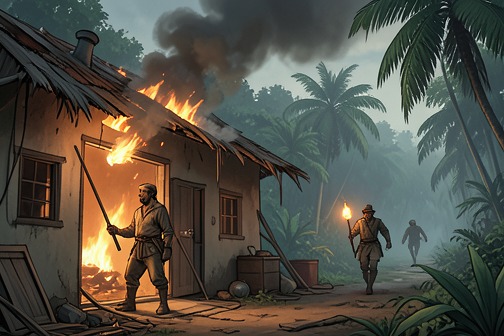
[Bardamu burns down the trading post and flees into the jungle](entity:event-recall-event-9d086212849d) after fever, fear of the Company, and the collapse of his isolated outpost make a return to [Fort-Gono](entity:location-recall-location-00fa5447385f) seem more dangerous than escape. The fire destroys the store and its accounts, but not the predicament behind them: carrying only a few possessions and cans of food, he follows [Robinson](entity:character-recall-character-robinson-29744adcf921)’s path into the bush. The episode turns a colonial clerk’s crisis into an abrupt break with the Company and with the prospect of submitting to its judgment.
## Causes and Background
[Bardamu](entity:character-recall-character-bardamu-9eb69ea71af7)’s fear is rooted in the work the Company has given him. In its main warehouse, he learns to number sacks and falsify weights amid a labor force subjected to the overseers’ clubs. The [Director](entity:character-recall-character-compagnie-porduri-r-b7f8eb57948f) checks that Bardamu is mastering both tasks. The arrangement makes the colonial enterprise’s claims of order inseparable from violence and deception, and leaves Bardamu implicated in the accounts he later dreads being asked to explain.
The Director’s maxim that everyone steals stays with Bardamu after Robinson disappears. As fever takes hold, the thought that the Company may call him to account becomes a fresh source of terror. He imagines a court-like process governed by secretive, punitive laws, and would rather remain delirious than face what might happen to him in Fort-Gono. He stops taking quinine, reasoning that fever might keep life away from him. This is not a considered plan for escape so much as a collapse in which illness and fear reinforce each other.
His isolation also has practical dimensions. Robinson has left him with no matches, while the drinking water is badly contaminated and the rainy season turns the outpost and its merchandise into a spreading mess. With a fever of 104 degrees, Bardamu is in no condition to make an orderly retreat. Yet the shortage of matches gives him an unexpected task: watching his cook start a fire with flint and dry grass, he decides to learn the method himself.
## The Fire and the Destruction of the Post
For about a month, Bardamu practices making fire with two stones. He is clumsy, but persistence gives him a rudimentary skill suited to the conditions around him. Fire becomes the one accomplishment he can rely on, even as the rain undermines his stock and his hopes of maintaining the trading post. His recollection of his mother’s saying, [“Nothing purifies like fire!”](entity:expression-recall-expression-nothing-purifies-l-dee78e32c6a3), supplies the act with a phrase that can be read both as inherited advice and as a grim permission to destroy what has become unmanageable.
The decisive blaze begins after sundown. Although his flints are poorly chosen and most sparks strike his hands, Bardamu manages to ignite a parcel of wet socks. The flames spread through the shack despite the dampness. Villagers gather as the crude rubber Robinson had bought sizzles in the fire. The smell recalls a telephone-company fire Bardamu once witnessed with his Uncle Charles, so the burning outpost briefly connects his present crisis with an earlier memory. The shack nevertheless burns to the ground, with the merchandise and accounts inside it.
Bardamu saves his personal belongings, his folding bed, three hundred francs, and a few cans of cassoulet. An hour after the fire begins, little remains of the shack; in the rain, villagers search among the ashes. The destruction removes the immediate burden of the store and its irregular accounts, but it also leaves Bardamu with no functioning post and no plausible way to present the disaster as an ordinary business failure.
## Flight and Its Stakes
Once the fire has died down, Bardamu considers two alternatives: returning to Fort-Gono to explain what happened, or leaving. He dismisses the first quickly. In his view, the world has no interest in explanation and is liable simply to crush a vulnerable person. Trusting other people, he concludes, is itself a form of being killed. The decision is therefore shaped not by confidence that the jungle is safe, but by his conviction that submission to human institutions offers no protection.
He sets out despite his weakened condition, heading into the bush in the direction Robinson took. This choice makes the fire more than an accidental consequence of fever and damp: it is the point after which Bardamu commits himself to flight rather than an attempt to restore his position with the Company. The account preserves the uncertainty of that decision. The post is gone, the Company remains behind him, and the jungle ahead is not presented as a secure refuge.
## Significance
The episode exposes the contradiction at the heart of the Company’s colonial order. Bardamu has been taught to falsify weights within a system that depends on coercive labor, yet his own fear centers on being held to account by that same system. The fire destroys the material record of his work, but it does not undo his involvement or resolve the danger he imagines in returning. Escape offers a way out of the immediate crisis, not absolution.
The practical details of the escape give it its force: a feverish clerk, a month of practicing with flint, damp goods, a burning parcel of socks, and a few cans carried away from the ashes. Bardamu’s mother’s saying turns destruction into an ironic kind of purification, while his choice to follow Robinson links the flight to an earlier departure. The trading post is erased, but the pattern of flight continues: Bardamu leaves one danger for another, with only the means to keep moving.
Event 9
Bardamu is sold aboard a galley at Santa Petta
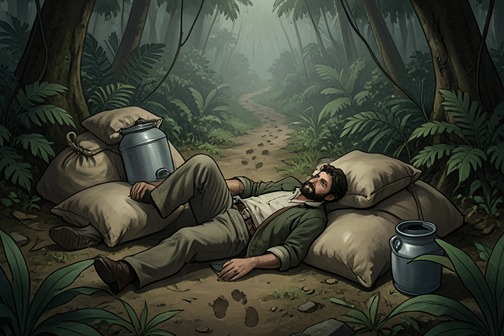
[Bardamu is sold aboard a galley](entity:action-recall-action-ed666e7b9a83) at [San Tapeta](entity:location-recall-location-b6cb0fddc8b2) while feverish, delirious, and too weak to understand his circumstances. The people who had carried him through the jungle leave him in a presbytery; taking advantage of his confused state, they sell him to the captain of the Infanta Combitta. He recovers enough to row, and the vessel carries him west across the Atlantic toward [New York](entity:location-recall-location-75b9ea4bd176). In this reversal, a journey away from colonial hardship becomes enslavement: movement continues, but only under someone else’s command.
## Causes and Background
The sale follows a punishing passage through the jungle. [Bardamu](entity:character-recall-character-bardamu-9eb69ea71af7) has been carried in a litter made of sacks sewn end to end, while fever and diarrhea leave him unable to see clearly; after several days, he can no longer distinguish the world from the fever images in his mind. His carriers could have abandoned him in a stream or eaten him, he reflects, but instead they bring him onward. Their apparent care therefore precedes a betrayal made possible by his physical helplessness.
The party reaches the Spanish colony of [Rio del Rio](entity:location-recall-location-62ae24c089a7) after meeting a solitary Spanish sergeant whose shack is overrun by migrating red ants. The sergeant gives Bardamu a passport on grainy paper bearing the arms of Castile, and Bardamu follows the road toward San Tapeta. By the time he arrives, he is too sick to remember the journey. The town appears lush from the roadstead, but at close range Bardamu sees people sweating and pustulating, as he had in [Fort-Gono](entity:location-recall-location-00fa5447385f). He dismisses his exhausted carriers, who say they fear for their lives on the return journey; he has suffered too much to summon sympathy for them.
San Tapeta’s presbytery offers shelter without meaningful communication or security. The priest fills Bardamu with herbal infusions while curious townspeople crowd around his bed, treating the bedridden stranger as a rare diversion. A gilded crucifix hangs over the priest’s belly, and coins clink inside his cassock when he approaches. Bardamu is so depleted that even attempting a few words exhausts him. The attendants’ presence does not prevent his exploitation: while he lies incapacitated, they make the decision that will determine his next passage.
## The Sale and Recovery
Bardamu regains consciousness to the repeated jolting and rocking of a vessel. He is still lying down, beneath an open porthole, in a cramped place that smells of ropes and tar. The movement and the sounds of footsteps overhead, voices, and waves tell him that his journey is continuing, though he does not yet know where he is. The physical sensations of the ship emerge before an explanation of the transaction that put him aboard.
He learns that the people of San Tapeta, exploiting his befuddlement, sold him to the captain of a galley. The Infanta Combitta is presented with grotesque magnificence: it has a high hull, oars, purple sails, a gilded figurehead, and officers’ quarters upholstered in luxury. On its prow is a painting of the Infanta Combitta, the ship’s royal sponsor. The ornament does nothing to alter the vessel’s function. Its splendor frames a system in which a sick man can be purchased and put to work.
Bardamu retrospectively weighs the sale against the alternatives he imagines. He believes he might have died in the presbytery, while a return to Fort-Gono could have exposed him to a lengthy punishment over his accounts. The captain, meanwhile, has taken a financial risk by buying him before the ship weighs anchor: Bardamu might have died before the investment paid off. The captain bets that sea air will revive him, and Bardamu’s gradual recovery appears to vindicate the wager. Survival here takes the form of an asset’s return to usefulness, not release from control.
## Forced Labor at Sea
When Bardamu is strong enough to rise, the captain mocks his attempts to sit up and tells him he will soon row with the others. He laughs and taps Bardamu on the back of the neck with his whip, describing the blows as friendly. The gesture makes the arrangement plain: the captain’s amusement and supposed kindness coexist with the whip and with Bardamu’s expected labor. The episode’s coercion does not require a formal declaration; the oars supply its practical meaning.
Bardamu recovers enough to join the rowers, although his fever still distorts what he sees: where there are ten oarsmen, he sees a hundred. The crossing is made mostly under sail, and he judges the conditions between decks no worse than those of ordinary third-class passengers on a [Sunday](entity:time-recall-time-sunday-073632221971) excursion train—and less perilous than his earlier passage aboard the Admiral Bragueton. This comparison registers a relative improvement in his immediate conditions without making him free. The voyage is long, the temperature drops, and Bardamu has had enough of both jungle landscapes and sea views to last him an eternity.
Once Bardamu is definitely recovering, the captain loses interest in him. Bardamu sees him only at a distance, like a boss, and remains too muddled to question him about the trip’s purpose. The captain’s initial attention had been tied to the gamble of acquiring a sick man; as Bardamu becomes a functioning oarsman, the need for close attention recedes. His recovery thus changes his position aboard the ship without changing the fact that he is being compelled to work.
## Absence, Arrival, and Significance
Bardamu searches among the galley slaves for [Léon Robinson](entity:character-recall-character-l-on-robinson-beb24b10f3f8) and repeatedly calls for him at night. The only response is insults and threats from the other rowers. Thinking back over what happened in San Tapeta, Bardamu suspects that Léon Robinson may have been sold too, though to another galley. He has no confirmation: the thought is an inference prompted by Bardamu’s own fate, not a reunion or established account of Léon Robinson’s whereabouts.
The people who brought Bardamu through the jungle had seemed comparatively kind, but he comes to attribute that kindness to sordid motives: they may have sold what they could not eat immediately. The conclusion turns hospitality into a form of exposure. Bardamu had been carried, given shelter, and treated while sick; none of those acts guaranteed protection once he could be exchanged for money. The episode extends the book’s pattern of survival through institutions and relationships that offer help only in compromised forms.
After weeks of alternating fever and seasickness, the ship anchors and its passengers discover New York through the fog. The city’s upright, rigid appearance astonishes them: unlike the cities Bardamu knows, which seem to lie along the coast or river, it stands stiffly before the sea. The galley slaves laugh at the sight, though the cold wind blows through the vessel and the city streets engulf the mist. Their arrival marks the consequence of the sale as well as a change of setting: Bardamu has crossed the Atlantic, but reaches the new city as an enslaved rower rather than a free traveler. The journey advances geographically while leaving his freedom behind.
Event 10
Bardamu escapes the galley and becomes a flea counter
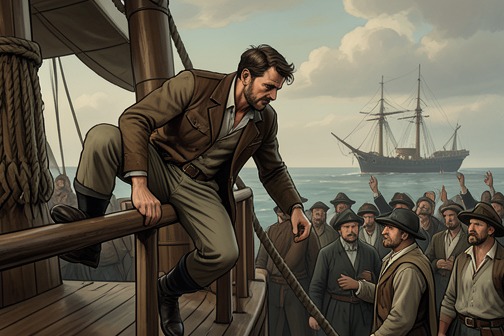
[Bardamu escapes the galley and becomes a flea counter](entity:event-recall-event-31e5724beaf0) through a calculated improvisation that turns an unwanted skill into his passage to [New York](entity:location-recall-location-75b9ea4bd176). The escape releases him from shipboard confinement, but not into uncomplicated freedom: quarantine, official suspicion, and the labor systems he encounters make his arrival a sequence of negotiations with authority. His flea statistics offer a comic, exacting parody of administrative progress, while his subsequent work in a [Ford factory](entity:location-recall-location-f2f56a95c5af) shows the bodily cost of becoming useful on an industrial scale.
## From the galley to the quarantine station
[Bardamu](entity:character-recall-character-bardamu-9eb69ea71af7) reaches the [United States](entity:location-recall-location-5d55e9152db1) aboard a galley as a feverish European whom he expects Americans to distrust. He has already identified a possible route ashore: his experience counting fleas could be presented as a technical service in a country that prizes technique. Before he can offer it, however, the galley is ordered to a quarantine station in a sheltered cove near a village, about two miles east of New York. The delay changes his escape from an immediate dash for land into a weeks-long effort to find an opening.
The galley’s water squad goes ashore each evening, and Bardamu knows he must join its trip if he is to pursue his plan. His shipmates understand what he intends, but they have little reason to follow him. The food aboard the Infanta Combitta is tolerable, punishments are limited, and their work carries the promise of a small pension at sixty-two. [Sunday](entity:time-recall-time-sunday-073632221971) mock elections provide another modest reassurance. Their security is meagre, yet it is familiar and protected by the fact that a galley slave cannot be fired.
Their reluctance is also directed specifically at the United States, which they dislike despite Bardamu’s confidence that he has acquaintances there, including [Lola](entity:character-recall-character-lola-2f3bbe3e3fd0) and [Robinson](entity:character-recall-character-robinson-29744adcf921). They warn him that his fever and his ideas will leave him worse off than they are. Even so, when Bardamu uses the water expedition as his chance to stay behind, they wish him luck. His departure is therefore both an act of individual escape and a break from a community that, for all its confinement, has settled into a survivable routine.
## Discovery and the flea-counting proposal
After leaving the galley, Bardamu finds an empty shack and sleeps there. In the morning, sailors are cleaning the streets and squares of the quarantine village. Hungry, he goes toward the smell of cooking and is spotted, surrounded, and taken to the Head Quarantine Officer. His fever and exhaustion make improvisation difficult, so he chooses to lose consciousness rather than try to talk his way out of the situation.
When he comes to, women in light-colored dresses question him in a comparatively gentle manner. The next day, however, the men again raise the prospect of prison. Bardamu then introduces flea-catching and counting as if it were merely a passing subject. He claims he can classify the parasites and produce reliable statistics, turning his unlikely experience aboard ship into a bid for employment rather than an excuse for his presence.
The station’s Surgeon General challenges the claim. Bardamu answers with a prepared argument: counting fleas, he insists, is a civilizing activity because enumeration underpins valuable statistical information, and a progressive country should know its fleas by sex, age group, year, and season. The grand language applied to an absurd subject is part of the performance. His pitch makes bureaucratic measurement sound like public service, while allowing him to present himself as a technical specialist rather than a suspect immigrant.
The Surgeon General does not accept the speech as proof. He says that other young Europeans have made similar claims and turned out to be anarchists, then threatens to put Bardamu in the water if he has lied. Instead, he gives him a trial assignment: count fleas among immigrants on [Ellis Island](entity:location-recall-location-c89bc4a396fa), where Major Mischief has been asking for an expert. The offer secures Bardamu’s next step, but it keeps his arrival conditional on the approval of officials who can still reject him.
## A statistical career at Ellis Island
Bardamu performs well enough to win Major Mischief’s trust. Mischief is nearly blind, and Bardamu dryly notes that this may help explain their good relations; more consequentially, he is delighted by Bardamu’s ability to catch and box fleas and identify their sex before removing them from an immigrant. A skill that began as a means of escape becomes competent work, and the trial assignment turns into a position within the quarantine station’s routine.
The work is both painstaking and grotesque in its scale. Bardamu’s thumb and forefinger are bruised by the end of the day, but he must still prepare columns of figures classifying parasites associated with immigrants of different nationalities. A special office in New York has electrical flea-counting machines for completing or checking the calculations, and a quarantine tug crosses the harbor each day to carry the figures there. The system devotes elaborate machinery and regular transport to measuring parasites carried by people whom it treats as an administrative problem.
Quarantine itself stretches on for weeks. The station’s purpose is not simply to observe arrivals: its installations are prepared for the possibility of a plague brought by a ship, and the account describes plans to kill foreigners to protect the city’s population. A cemetery is ready, decorated with flowers; the authorities have been waiting for sixty years. Against this long, immobile expectation, the daily transfer of Bardamu’s numbers looks like action, but it remains action inside a system organized around suspicion and exclusion.
## The opening closes, and the next one leads to the factory
As Bardamu’s health recovers, the station becomes comfortable enough that he could remain there, well fed and no longer in immediate danger. But the return of his appetite for adventure makes security feel like another kind of confinement. In the twenty-third week of his stay, the Armenian employee responsible for taking the statistics to New York is promoted to count fleas on the dogs of prospectors in Alaska. Bardamu is assigned to carry the figures in his place.
Mischief shakes his hand and advises him to behave in town. Once ashore, rain soaks Bardamu’s thin jacket and dissolves the statistics in his hand. He gathers some of the wet pages into a wad and leaves them protruding from his pocket to resemble a businessman’s papers. The official errand has become useless, but the appearance of having business helps him cross into the city. His progress depends less on a stable credential than on another improvised performance.
In New York, Bardamu seeks work at the Ford factory. When he mentions that he once studied medicine, a supervisor tells him that the factory needs obedience and repeated movements, not imagination or intelligence. Bardamu takes the warning seriously and resolves to pass as a quiet worker. The enormous building vibrates with its machinery, and the new recruits are sorted into groups, each assigned to a machine. The transition from quarantine statistics to factory labor shifts the form of discipline, but not its demand that a person become useful on prescribed terms.
Bardamu is first assigned to pass linchpins to a blind man who has calibrated them for years. He performs badly and, after three days, is moved to push a trolley of washers between machines, leaving different quantities at different stations. No one needs to reprimand him: the work has already reduced existence to hesitation between stupor and frenzy, governed by the continuous noise of the machines. At the end of each shift, the noise follows him home, along with the smell of oil.
## Significance
The escape and the flea-counting job form an episode in which Bardamu survives by converting vulnerability into a performance of expertise. Fever, hunger, and uncertain status threaten to leave him at the mercy of quarantine officials; a claim to technical skill gives them a reason to employ him instead. Yet the apparent rescue brings him into another structure of classification, where immigrants become the bearers of countable parasites and the counts themselves travel through dedicated machines and offices.
The episode also links two labor regimes without making them identical. At the quarantine station, Bardamu’s work depends on close attention, manual dexterity, and the production of statistical categories. At Ford, a supervisor explicitly rejects thought in favor of prescribed movements, and Bardamu’s tasks become interchangeable parts of a mechanical sequence. In both settings, institutions value the worker insofar as he can serve a process; the contrast lies in the kinds of skill they demand and in how directly the factory attempts to extinguish individual judgment.
Bardamu’s comic treatment of the flea census exposes the disproportion between its minute subject and the immense apparatus built to count it. The irony sharpens when the surrounding quarantine system is shown preparing to exclude or kill foreigners in the name of protecting the city. His route into New York is thus neither a triumph of merit nor a straightforward liberation: it is a precarious passage secured by usefulness, accident, and self-invention, with the next workplace already waiting to claim his time and movements.
Event 11
Bardamu enters Manhattan

[Bardamu enters Manhattan](entity:event-recall-event-4ecc3f234e3e) as a poor and anxious newcomer whose arrival turns the promise of America into an encounter with overwhelming scale, crowded streets, and uncertain prospects. Sent from a colonial station to carry statistics to [New York](entity:location-recall-location-75b9ea4bd176), he reaches the city in heavy rain with his papers soaked and his confidence largely improvised. [Manhattan](entity:location-recall-location-5e470c74b89c) first appears to him as a near-sacred center of money and power, then as a place where beauty can briefly resemble a miracle—even while hunger and insecurity remain close at hand.
## Arrival and the journey into the city
[Bardamu](entity:character-recall-character-bardamu-9eb69ea71af7)’s entry into Manhattan follows his assignment to take the station’s figures to New York. Before he leaves, his superior, Mischief, shakes his hand and advises him to behave himself in town. Once ashore, Bardamu is caught in a downpour: rain penetrates his thin jacket and gradually dissolves the statistics in his hand. He gathers some of the surviving papers into a bundle and lets it protrude from his pocket, hoping the makeshift display will help him pass for a businessman. The pose is less a sign of arrival than a small defense against exposure; trembling with fear and excitement, he hurries off in search of what comes next.
The city first confronts him as an oppressive wall of similar-looking windows. Looking up at the ramparts of the buildings gives him a kind of reverse vertigo, and he seeks the darkest opening in the façade, hoping not to attract notice. He enters a narrow, dirty, damp street crowded with people moving toward work. The crowd carries him along like a shadow, making his uncertainty part of a larger stream of poor city-dwellers.
Bardamu then changes direction and finds Broadway. Above the upper stories he can still glimpse daylight, gulls, and pieces of sky, but at street level the light is gray and sickly. He describes the street as an endless gash filled edge to edge with people, all moving forward without a visible destination. There are no cars or carriages in this scene, only more pedestrians. His first experience of New York is therefore not of individual freedom or easy movement, but of being absorbed into a mass whose route and endpoint remain obscure.
## Manhattan’s money and its rituals
Only later does Bardamu learn that he has entered Manhattan’s gold district, the banking heart of the modern world. Its wealth seems almost miraculous, and he imagines the sound of dollars being handled as a kind of sacred presence. Yet the district’s solemnity does not erase the ordinary behavior of its inhabitants: people spit on the sidewalk as they pass. The contrast punctures the grandeur without making the money less powerful.
He visits a bank and speaks to the employees guarding its cash, whom he finds sad and underpaid. To him, the bank resembles a religious institution: customers address money through a small grill, in a dimly lit space beneath high arches. The arrangement evokes a confessional, but the analogy also draws attention to exclusion and restraint. Money may be treated as an object of worship, yet access to it remains controlled, and those charged with guarding it do not share in its splendor.
The view opens when the crowded street suddenly widens into a bright clearing between enormous buildings. At its center stands City Hall, a comparatively modest, old-fashioned building surrounded by neglected lawns. A passerby tells Bardamu that it is an ancient colonial monument retained for its historical value. The explanation gives the building a past, but Bardamu’s immediate experience is shaped by the present crowd and the brief oasis in which he has stopped. After more than an hour on a bench, he watches people emerge from the dim, shuffling stream into a sudden procession of women he finds strikingly beautiful.
## The America he imagined
The women’s appearance seems to confirm Bardamu’s hopes about America. He thinks of [Lola](entity:character-recall-character-lola-2f3bbe3e3fd0) and takes the scene as proof that her promises were not entirely false. In the moment, the beauty before him seems capable of turning his arrival into an aesthetic revelation, and he imagines the women as figures who might lift him beyond his ordinary life. His response is deliberately unstable, however: he admits that hunger keeps interrupting his enchantment. A sandwich, he suggests, would be enough to make him believe in miracles, and he is painfully aware that he needs one.
Bardamu’s admiration gathers intensity as more women appear. He sees their variety and elegance as an impossible abundance, and briefly imagines that he has arrived at the beginning of a new Greece. Yet this vision is not a relationship or a welcome. The women seem unaware of him as he sits nearby, absorbed in his own mixture of erotic fascination, illness, and hunger. He believes that a gesture or a word from them might carry him into a world of dreams, but they have other concerns. The gulf between his fantasy and their indifference leaves him in a state of stupefaction rather than connection.
## Significance and aftermath
The passage makes Manhattan both a destination and a test of Bardamu’s expectations. Its banking center concentrates the promise of wealth, but the guarded cash, underpaid employees, crowded streets, and poor workers complicate the image of a city organized around opportunity. Even the women who seem, for a moment, to fulfill his hopes remain distant; beauty does not feed him or resolve his isolation. The city’s scale turns him into one shadow among many, while its spectacle encourages private fantasies that cannot change his material circumstances.
His arrival also marks a transition from colonial employment toward an uncertain urban life. The statistics that were supposed to justify his journey are ruined by rain before he can deliver them, and the businesslike identity he tries to perform depends on a wad of damp papers. The episode closes not with a settled purpose but with Bardamu still sitting in wonder, aware that he has nothing more in the world to hope for. That bleak ending undercuts the apparent miracle of Manhattan: the city can astonish him, but it does not yet provide either security or belonging.
Event 12
Ferdinand’s dispute with Lola over a loan
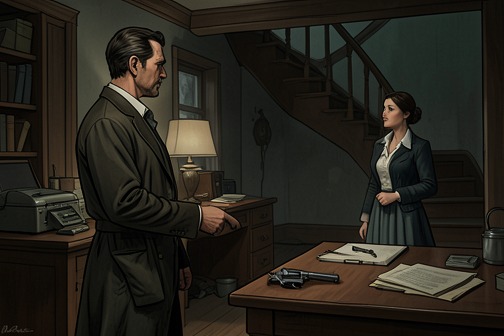
[Ferdinand’s dispute with Lola over a loan](entity:event-recall-event-9793c7a86bce) is a coercive encounter in which money, illness, and intimacy become weapons. [Lola](entity:character-recall-character-lola-2f3bbe3e3fd0)’s disclosure that her mother has cancer briefly makes her appeal to [Ferdinand](entity:character-recall-character-ferdinand-e88c57ad784c) for comfort; he instead declares the disease incurable and turns her fear into leverage. She pays him one hundred dollars to leave, but his additional demand for a kiss brings the quarrel to its limit: Lola produces a revolver, Ferdinand takes the stairs, and the next day he departs for [Detroit](entity:location-recall-location-67107b1c9592).
## Background and the Demand
The confrontation follows a cold car ride through rain-darkened streets. Lola has been determined to put Ferdinand out as soon as possible, while he privately tells himself that being repeatedly thrown out may eventually carry him to whatever frightens people at [the end of the night](entity:expression-recall-expression-the-end-of-the-nig-1623ad422e5d). The two arrive at Lola’s living room, where Ferdinand wonders what sum she will pay to be rid of him.
Lola takes banknotes from a small handbag left on the table. Their loud rustling fills the room, and Ferdinand, embarrassed by the transaction, abruptly asks after her mother, whom he had forgotten. The question changes the direction of the scene: instead of settling the debt, it opens a private subject that will expose Lola’s anxiety and give Ferdinand a new means of pressure.
## Illness and the Reversal of Power
Lola says her mother is in Chicago and has cancer of the liver. She has entrusted her to the finest specialists in town, who cost a fortune and have promised that they will save her. As Lola supplies more details, her concern for her mother makes her appeal to Ferdinand for reassurance. She asks whether he believes the doctors can cure her.
Ferdinand answers no, stating that liver cancer is absolutely incurable. Lola turns deathly pale, and the doctors’ confidence—backed, she says, by a written guarantee—fails to settle her fear. Ferdinand counters that there will always be great doctors for cash, and says he would act as they do if he were in their place; Lola, he adds, would do the same. His bluntness is not presented as a disinterested medical judgment: he recognizes that her distress has weakened her resistance and that he has gained the advantage in their dispute.
## Money as Leverage
Lola insults Ferdinand, but he takes satisfaction in feeling increasingly indifferent, even joyful, as the abuse continues. He calculates that she will have to give him at least twenty dollars to make him go, perhaps more. He then threatens to remain and repeat everything he knows about cancer, its complications, and its hereditary character unless she lends him the money he says she promised.
The threat makes Lola blanch and crumple as Ferdinand elaborates on her mother’s case. His knowledge, whether medically sound or strategically deployed, becomes an instrument of coercion: he keeps her attention fixed on the illness she fears most and presses the advantage instead of offering comfort. The original financial disagreement has become a struggle over who can control the meaning of the diagnosis and the terms of the encounter.
## Payment, Threat, and Departure
Lola finally screams at Ferdinand to take the hundred dollars, leave, and never come back. The payment is larger than the amount he had privately anticipated, but it does not end his attempt to dominate the exchange. He asks her to kiss him all the same and suggests that they remain friends, explicitly testing how far he can disgust her.
Lola answers the provocation by taking a revolver from a drawer; the threat is real, not a bluff. Ferdinand does not ring for the elevator but escapes by the stairs. The next day, the encounter has restored his taste for work and raised his morale. He takes the train to Detroit, having been told that jobs there are easy to get, plentiful, well paid, and not too exhausting. His departure gives the quarrel an immediate practical consequence, while its violence and humiliation remain unresolved.
Event 13
Ferdinand’s brief employment at the Ford factory
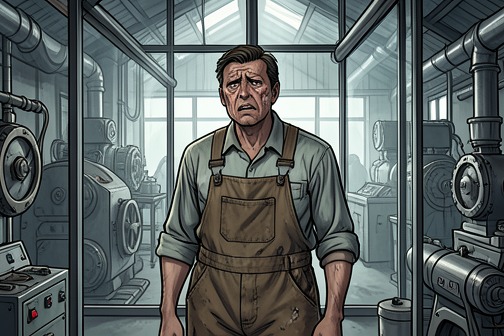
[Ferdinand’s brief employment at the Ford factory](entity:event-recall-event-c927381a628c) is a defining encounter with industrial labor as a system that demands obedience, breaks work into repetitive operations, and treats workers as replaceable. Recruited despite poor health and told that thought and intelligence are unwanted, he is drawn into a vast mechanical environment that overwhelms his senses and narrows his work to simple motions. He cannot sustain the job: after performing badly at one task, he is transferred to another, then fails to return. When he learns that a machine has taken his place, the factory’s promise of employment is exposed as conditional and impersonal.
## Recruitment and the factory’s terms
In [Detroit](entity:location-recall-location-67107b1c9592), [Ferdinand](entity:character-recall-character-ferdinand-e88c57ad784c) follows directions to a large glass-fronted complex whose machinery is audible before he reaches it. A notice at the entrance says that men are wanted. The waiting workers include men who have traveled far for work; they stand crowded together, distrustful and economically vulnerable. One older Russian, a former taxi driver, warns Ferdinand that Ford hires almost anyone but will quickly replace a worker who makes trouble. The warning gives the recruitment scene its governing condition: entry is easy, but continued employment depends on submission and can end without recourse.
The intake examination makes that condition explicit. The recruits are stripped for a medical inspection, and an assistant tells Ferdinand that his health is poor but irrelevant. Ferdinand mentions that he has studied medicine, apparently hoping his education may matter. Instead, the doctor warns him not to mention intelligence again: the factory needs workers who perform instructed movements, not imaginative people who think for themselves. Ferdinand resolves to pass as a quiet laborer. The factory is not selecting for health or skill so much as preparing bodies for assigned tasks.
## From colonial warehouse to mechanized labor
The factory’s discipline recalls Ferdinand’s earlier work for [Compagnie Pordurière](entity:organization-recall-organization-compagnie-pordur-b5056a590d6b) in the colonies, where he learned to number sacks amid a crowded warehouse. There, laborers were driven by overseers’ clubs while the [Director](entity:character-recall-character-compagnie-porduri-r-b7f8eb57948f) checked that Ferdinand was learning to number sacks and falsify weights. The warehouse and the automobile plant differ in their machinery and setting, but both organize work through imposed procedures and place the worker within a hierarchy that controls pace, task, and value. In the factory, the replacement for the overseer’s visible blows is the relentless machinery and the instruction to obey rather than think.
Once Ferdinand enters the plant, its scale and noise engulf the recruits. They are taken through the building in slow-moving groups; workers disappear from the group as they are assigned to individual machines. The recruits exchange bright smiles as they lose the ability to hear or speak to one another. Ferdinand describes the workers and himself as becoming machines, their bodies caught in the building’s continuous vibration. The scene presents mechanization not simply as the use of equipment but as a transformation of human labor: bodies are absorbed into the factory’s rhythm, while communication and independent attention fall away.
## Repetitive work and failure
Ferdinand’s first assignment is to pass linchpins to a blind worker who has spent years calibrating them. He performs the operation badly. After three days, without a reprimand or explanation, he is transferred to pushing a small trolley of washers between machines, leaving three at one station, a dozen at another, and five at a third. Each task is reduced to a narrow, repeated operation; the variation in his deliveries records his inability to fit the prescribed routine. Work becomes a suspended state between stupor and frenzy, governed by the machines’ unbroken continuity.
The consequences continue after the shift ends. At six o’clock the factory stops, but Ferdinand carries the noise in his head throughout the night, along with the smell of oil. He describes himself as gradually becoming a different man, while the other factory hands seem to him like extensions of the machines. The job leaves little space for reflection or contact: its demand is not merely that he do the task, but that he surrender attention and time to a process that continues independently of him.
## Absence, replacement, and significance
After several weeks, Ferdinand attempts to return to the factory, but reaches the gate and freezes at the thought of the machines waiting inside. His brief effort ends before he resumes work. Outside the glass front of the power plant, he meets the Russian worker who had warned him about replacement. The man tells Ferdinand that he has been fired for failing to appear for three weeks and that a machine has already taken his place. Ferdinand accepts the news as an end to the obligation and returns to town.
The episode’s decisive reversal is that the machinery which first seemed to engulf Ferdinand can also occupy his position without him. His absence does not interrupt production; it only clears space for another mechanism. That outcome sharpens the contrast between a worker’s vulnerability and the factory’s continuity. The recruitment process welcomes the desperate, the work suppresses thought and differentiating skill, and dismissal follows as soon as the worker is no longer present. Ferdinand’s experience at Ford thus extends the book’s wider attention to institutions that classify and use human bodies, while showing industrial employment as a particularly efficient form of disposability.
Event 14
Ferdinand and Molly part ways
[Ferdinand and Molly part ways](entity:event-recall-event-54e4d8171b28) when [Ferdinand](entity:character-recall-character-ferdinand-e88c57ad784c) leaves the woman who has offered him affection, practical counsel, and a future in America, choosing instead the restless impulse that has repeatedly carried him away. The separation is not the result of a quarrel or a collapse of feeling: Molly understands his nature, and Ferdinand remains deeply attached to her. Its decisive force lies in the contrast between the life she makes imaginable and the departure he cannot stop himself from choosing.
## The life Molly offers
Molly’s attempt to keep Ferdinand is loving and concrete. She imagines that they could remain in America, invest their savings, and buy a small business, becoming like other people. She presents the plan partly to quiet his scruples, but the offer is more than a practical arrangement: it is a chance to build an ordinary shared life. Ferdinand agrees with her and feels ashamed of the effort she is making to hold him. He is fond of Molly, yet admits that he is fonder still of his “mania for running away from everywhere in search of God knows what.” He attributes that compulsion, uncertainly, to pride and a sense of superiority.
Molly’s care extends beyond the proposed future. Ferdinand tells her about the impulse that drives him to leave wherever he happens to be, and she listens for days as he exposes his anxieties and pride. She does not always understand his explanations, but she takes his side against his phantoms—or alongside them—and tries patiently to help him overcome his distress. Her kindness makes him feel less alone, but also unsettles the identity he has built around flight. As he grows accustomed to her attention, he begins to withhold what passes through his mind, feeling that intimacy may amount to cheating on his supposed destiny. He retreats inward and becomes more miserable, now with a new distress born of something like genuine feeling.
## The decision to leave
The separation develops through Ferdinand’s recognition that Molly’s unhappiness is real. After arranging another meeting with [Robinson](entity:character-recall-character-robinson-29744adcf921), he returns to Molly and tells her the whole story. She tries not to show how much it hurts her, but her heartbreak is unmistakable to him. Her occasional reproaches remain gentle: she asks whether he knows what he wants and reminds him that, back in [France](entity:location-recall-location-4f282e1af8a7), he will have to earn a living rather than spend the night roaming and dreaming while she works. Ferdinand acknowledges that she is right, yet says he cannot help being what he is. He is afraid of hurting her precisely because she is so easy to hurt.
He nevertheless assures her that he will finish medical school in France and then return. Molly sees through the promise and tells him that he will not come back, and that she herself will no longer be there. The leave-taking follows shortly before she is due to start work. They go together to the station; Ferdinand has already said goodbye to Robinson earlier that day. On the platform, men pass while pretending not to know Molly, though they exchange whispers. The public awkwardness forms the setting for a private farewell in which Molly names what Ferdinand is doing: he is already far away and is following what he wants, which, she says, is the only thing that counts.
## The station farewell
When the train arrives and Ferdinand sees its engine, he becomes less certain of his plans. He kisses Molly with what spirit he has left and, for once, feels truly sad—not only for her or himself, but for everybody. The moment does not reverse his decision; it reveals its cost. His departure turns a cherished possibility into a loss at the very instant he acts on the impulse that has made departure feel necessary.
Ferdinand reflects that perhaps people spend their lives seeking the worst grief, because it makes them truly themselves before death. The thought gives the farewell a significance beyond a romantic parting: sorrow becomes a rare proof of feeling in a life otherwise organized around evasion. Yet the recognition comes too late to make him stay. Molly’s clear-eyed understanding and his sudden sadness coexist with the irreversible movement of the train.
## The years after separation
Years pass, and Ferdinand writes repeatedly to [Detroit](entity:location-recall-location-67107b1c9592) and to other addresses where he thinks Molly might be known. No answer reaches him. The only news he can find is that the house is closed. His continued attempts to contact her show that departure has not extinguished his attachment, though the silence leaves their later lives unknown.
Addressing Molly across that distance, Ferdinand says his feelings have not changed and that he still loves her in his own way. He offers her a place with him and a share of his bread and furtive destiny, even if she is no longer beautiful. He insists that he has kept so much of her beauty within himself that there is enough for both of them. The offer is tender, but it belongs to an imagined reunion rather than a restored relationship: he has no reply, and the passage establishes no return.
## Significance of the choice
Ferdinand judges the act of leaving as a kind of madness, committed coldly and disgustingly. He does not excuse himself by claiming that love was absent. Instead, he credits Molly’s kindness and the dream she gave him during his few months in America with preserving his soul in one place and keeping him from becoming as cold, ugly, and heavy as other men. The separation thus leaves a paradoxical inheritance: the relationship fails as a shared future, but remains a source of moral warmth in Ferdinand’s memory.
Molly’s offer exposes the difference between escape as an idea and the intimate obligations that staying would entail. Ferdinand can agree to plans, accept care, and feel shame at the pain he causes, yet still return to the road. The farewell’s emotional movement is not from love to indifference but from possible happiness to chosen absence. His later letters preserve affection without undoing that choice, making Molly at once the person he leaves and the remembered kindness against which he measures his own capacity for feeling.
Event 15
Ferdinand returns to France and opens a practice in La Garenne-Rancy
[Ferdinand returns to France and opens a practice in La Garenne-Rancy](entity:event-recall-event-2f32c67666ed) after a precarious interval of odd jobs and years of medical study. The episode turns his hoped-for fresh start into an encounter with a poor suburb where professional credentials bring little security and medical care is constrained by uncertainty, gossip, and deprivation.
## Return and Medical Training
For weeks and months, [Ferdinand](entity:character-recall-character-ferdinand-e88c57ad784c) lingers around Place Clichy and the Batignolles, taking whatever work he can find. The routine offers no clean break from the past: he describes the days as a precarious thread waiting to be picked up, while work in the heat of the traffic recalls the strain of Ford’s factory. In his free time, usually alone, he thinks over books, newspapers, and what he has seen.
He resumes his studies while working for a living, then passes his examinations after five or six years of academic difficulty. The degree gives him formal standing, but his sardonic view of medical education remains: science is guarded behind institutional barriers, and the qualification seems more impressive on paper than generous in what it provides.
## Opening a Practice in Rancy
Ferdinand establishes himself in the suburbs, in [La Garenne-Rancy](entity:location-recall-location-la-garenne-rancy-fdd2a230e27d) just beyond the Porte Brancion on the way out of [Paris](entity:location-recall-location-paris-c02b439ce220). He does not set out with grand professional ambitions. He wants room to breathe and enough income to eat somewhat better, so he puts his nameplate above the door and waits for patients.
The local residents do not immediately trust the sign. They ask the police station whether he is a real doctor and learn that he has filed his diploma. Word then spreads that a qualified physician has opened among the neighborhood’s other doctors. His concierge predicts that he will never make a living because there are already too many practitioners; the narrator concedes that she is right. His arrival therefore establishes a practice, but not an assured livelihood.
## The Neighborhood and Its Conditions
Rancy is presented through the daily movement of workers and the built environment that confines them. Streetcars begin running at dawn along Boulevard Minotaure, carrying people toward work. The young workers appear cheerful, clinging to the running boards and laughing, but Ferdinand’s perspective is shaped by long familiarity with the neighborhood’s squalor and routine. Its houses feel like prisons: their interiors are neglected, their façades flat, and their absent landlords deal with tenants through agents.
The setting also recalls [Detroit](entity:location-recall-location-67107b1c9592). Rancy’s smoky sky, industrial chimneys, and buildings sunk in black urban grime make the suburb seem less like a new beginning than another version of the industrial landscape Ferdinand has left behind. His medical practice is planted in a place where poverty is ordinary and the environment itself offers little relief.
## Medical Work and Its Limits
The later cases that follow the opening of the practice show what this position entails. At the Gagat household, Ferdinand is called to a young woman who is losing a great deal of blood. Her mother is consumed by fear of neighborhood judgment, and the father waits uncertainly in the next room. Ferdinand cannot resolve the emergency in the circumstances he finds, while the family’s concern about appearances obstructs a clear response. The episode exposes the distance between possessing a medical qualification and being able to secure effective care.
[Bébert](entity:character-recall-character-b-bert-f544feedeebe)’s illness makes that limitation more prolonged and painful. Ferdinand treats the child for a severe, baffling case of typhoid, trying baths, serum, a dry diet, and vaccines without success. He seeks further advice at the [Joseph Bioduret Institute](entity:location-recall-location-c4720448c1b9), driven partly by the wish to know that he has tried everything possible. There he consults [Serge Parapine](entity:character-recall-character-serge-parapine-ed785f0bf934), a former medical-school instructor who is willing to help but has accumulated so much contradictory knowledge that he cannot offer a definite view of treatment. Ferdinand’s professional responsibility persists even when the available expertise cannot give him certainty.
Bébert dies despite Ferdinand’s efforts, and the neighborhood’s judgment compounds the failure: gossip about an earlier case circulates, while other doctors are reluctant to take on the child once they know the illness. Ferdinand is retained because Bébert has already fallen to his care. The episode thus links his modest suburban opening to an enduring ethical burden: he must answer for outcomes he cannot control, even as poverty, suspicion, and the limits of medical knowledge narrow his choices.
## Significance
The return and opening of the practice mark Ferdinand’s entry into a new phase of life without suggesting that he has escaped hardship. His medical degree offers a recognized identity, but not prosperity or authority in the neighborhood. The skeptical residents, the concierge’s prediction, and the later cases all test the difference between being officially qualified and being able to help.
Rancy also extends the book’s contrast between social performance and material conditions. A doctor’s nameplate and diploma promise competence, while the suburb’s crowded work routes, neglected housing, and difficult cases reveal how little those signs can alter the lives around him. Ferdinand’s practice gives him a place in the community, but its recurring crises make that place one of precarious service rather than secure success.
Event 16
The Henrouilles attempt to have Grandma committed
The Henrouilles’ attempt to have [Grandma Henrouille](entity:character-recall-character-grandma-henrouille-4862e4914894) committed is a family campaign presented as concern for her welfare but driven in part by financial pressure and the desire to control her home and pension. The consultation brings [Ferdinand Bardamu](entity:character-recall-character-ferdinand-bardamu-9de4af40bdf1) into the dispute as a doctor whose judgment might make confinement possible. Grandma refuses to accept the family’s definition of her as insane, confronts [Bardamu](entity:character-recall-character-bardamu-9eb69ea71af7), and sends him away; he abandons the prospect of earning a thousand francs rather than complete the plan.
## Background and the request for commitment
Grandma Henrouille’s relatives ask Bardamu to see her after [Bébert’s Aunt](entity:character-recall-character-b-bert-fb2fa7082e7b) has recommended him as a kind and considerate doctor. They ask whether he can prescribe something to keep the old woman quiet, but their larger aim is to have her committed. Their appeal rests on claims that she no longer goes out, refuses their care, lives in cold and poor conditions, and might set the house on fire. Her daughter-in-law frames institutional confinement as a way to provide care, while pressing Bardamu to agree that Grandma is mad.
Grandma has scarcely left her home in twelve years. The narration treats that isolation as a fact, not proof of insanity: her reasons remain undisclosed, and the possibility that she fears losing something is raised without being confirmed. When her family tells her that she is not strong enough to go to work, she insists that she is. Her resistance to leaving home is matched by a refusal to let others decide what her behavior means.
## The family’s interests
After the visit to Grandma’s home, Bardamu returns with her son, [Monsieur Henrouille](entity:character-recall-character-monsieur-henrouille-766089ad3405), and her daughter-in-law. The daughter-in-law continues to press the case, presenting the old woman’s living conditions and refusal of help as reasons that commitment is necessary. She also invokes the rising cost of living and says that Grandma’s pension is no longer enough. The couple, she suggests, cannot remain indefinitely responsible for an old woman who might die without proper care or cause a fire.
The conversation reveals a more openly material interest when Monsieur Henrouille suggests that the family could rent Grandma’s small house. His wife reacts by stepping on his foot under the table, signaling that he has said too much in front of the doctor. Their appeal combines professed concern for Grandma with the possibility of benefiting from her property and relief from the burden of her pension and care.
## Bardamu’s role and the failed plan
Bardamu recognizes that a commitment certificate could earn him a thousand francs at once. His poverty makes the offer consequential: he thinks that the family regards him as a doctor who would do what they asked because he is so hard up. The episode therefore places medical authority within an unequal exchange. A certificate could turn the relatives’ allegations into an institutional decision, while Bardamu’s financial need gives him a reason to cooperate despite the uncertainty of their case.
Before he can act, Grandma returns from the far end of the garden and interrupts the family’s discussion. She directly accuses Bardamu of being paid to help them and declares that she will not go to an institution or to the Sisters. She also predicts that the relatives, rather than she, will face consequences for their conduct. Her accusation makes explicit what the family had tried to present as a private medical consultation: a scheme in which the doctor’s signature could help remove her from her home.
## Outcome and institutional significance
Bardamu leaves without making the certificate, and the attempt fails at the point where Grandma confronts the people plotting over her future. In the rain outside, she continues to call after him. His departure avoids immediate participation in the plan, but it does not resolve the family’s conflict or establish what will ultimately happen to her. The decisive outcome of this episode is narrower: the relatives do not obtain his help in committing her.
The scene belongs to a wider pattern in which institutions claim to classify, supervise, or care for people while also directing their bodies and choices. During the war, Bardamu had been placed under observation because his patriotism was considered impaired, and he saw how administrative safeguards and medical procedures could accompany the expectation that wounded men would return to the front. At Ford’s, an examination was followed by a blunt insistence that workers were not there to think, but to perform assigned movements. These episodes do not make Grandma’s situation identical to Bardamu’s, but they sharpen the recurring distinction between care as it is announced and control as it is exercised.
The later rest-home routine extends that institutional motif into ordinary administration: patients are counted on a roll call, sent to their rooms, and monitored under rules shaped partly by the establishment’s reputation. Against that background, the Henrouilles’ effort to secure commitment is not simply a dispute over whether an old woman is eccentric. It asks who has the power to interpret her refusal, whose interests a medical judgment serves, and how easily an appeal to care can become a means of confinement.
Event 17
Ferdinand berates a sick child and is thrown out of the home
[Ferdinand Bardamu](entity:character-recall-character-ferdinand-bardamu-9de4af40bdf1) berates a sick child and is thrown out of the home after the boy’s screams overwhelm him during an examination. The episode is more than a professional lapse: it makes visible the return of [Bardamu](entity:character-recall-character-bardamu-9eb69ea71af7)’s war-shaped fear and the renewed distress brought on by [Léon Robinson](entity:character-recall-character-l-on-robinson-beb24b10f3f8), while converting his private exhaustion into a public scandal that costs him the family’s confidence and his fee.
## Causes and Background
By the time of the visit, [Robinson](entity:character-recall-character-robinson-29744adcf921)’s sudden reappearance has unsettled Bardamu’s already precarious routine. He suspects Robinson is responsible for his trouble starting up again. At first he treats the spells as something he can work through, dragging himself from patient to patient; then the uneasiness grows, he sleeps worse, and the encounter begins to feel like a shock that has brought back an old, persistent bad dream. Robinson’s misery seems to Bardamu to carry the weight of a life from which he cannot free himself. He even fears meeting him in the neighborhood and avoids going out.
The deterioration has practical consequences before the scandal. Patients sometimes have to send for Bardamu two or three times before he decides to visit, and by the time he arrives they have often called another doctor. The Gagat family’s summons reaches him in a car, taking him to 12 Rue Saint-Vincent, on the fourth floor of a house he has visited once before. The grandfather, gray and stooped, wipes his feet carefully on Bardamu’s doormat and urges him to hurry because his grandson is ill. That deferential reception makes the later expulsion a sharp reversal.
The child’s illness sits within a strained family situation. His mother, the grandfather’s daughter, is an unmarried woman who has returned to her parents for abortions; the grandparents are raising her two-year-old son. The child’s putative father has left after repeated talk of marriage. The family grieves over the boy’s illness, and Bardamu observes that they connect his vulnerability with his illegitimacy, though they do not quite admit that belief to themselves. The household’s distress and Bardamu’s own agitation meet in the dining room, where the child is laid on the table for examination.
## The Examination and Outburst
Bardamu examines the boy with deliberate care, palpating his abdomen from the navel toward the testicles and then listening to his chest. He registers the child’s heartbeat as sharp and nervous, like a kitten’s. The boy soon has had enough of the examination and begins to scream. Bardamu, already feeling strange in body and mind since Robinson’s return, cannot bear the noise. He describes himself as being at the end of his rope, and the child’s cries become the immediate trigger for words he has been holding back.
Instead of soothing or reassuring the patient, Bardamu tells him not to hurry, because there will be plenty of time to bellow and enough misery ahead to melt his eyes, his head, and everything else. The cruelty lies partly in the mismatch between the helpless child before him and the vast, hopeless forecast Bardamu lays upon him. His speech turns the doctor’s encounter with a particular sick boy into an eruption of his own accumulated rancor and disgust. Bardamu later recognizes that he has deliberately let loose what he had been holding in, but the outburst does not free him from the source of his distress.
The family’s response becomes another performance of alarm. The grandmother starts in surprise; the mother, described by Bardamu as being invested in her new responsibilities, makes a strange face and launches into prolonged screams of her own. She kicks, chokes, and squints, cries that the doctor is mad, and demands that her mother take the baby away. Bardamu’s pessimistic remarks have reversed the expected roles of the examination: the doctor is now treated as the immediate danger, and the child is seized from his hands as if rescued from flames.
## Expulsion and Consequences
The grandfather’s conduct changes just as abruptly. After having been deferential enough to wipe his feet on the doctor’s mat and fetch him by car, he unhooks an enormous mahogany thermometer from the wall. He uses it like a club and pursues Bardamu at a distance to the door, which he slams violently behind him with a kick. The family does not pay for the visit. Bardamu is left outside, dissatisfied with what has happened, though he says his damaged neighborhood reputation is not the main reason for his displeasure.
He had hoped that an outburst of frankness would help him deliver himself from Robinson and give him the strength never to see him again. Instead, the scandal offers no such escape. Bardamu understands the scene as an experiment in how much trouble one eruption can make, but it also reveals the futility of expecting a single frank gesture to end a larger entanglement. In his view, scenes and tantrums do not finish cleanly: they leave the possibility of further revelations and further exposure, and the whole business may have to begin again.
The incident spreads beyond the house. By the time Bardamu is caring for [Bébert](entity:character-recall-character-b-bert-f544feedeebe), the story of the girl with the new responsibilities has circulated through the neighborhood and been widely discussed. The gossip makes it easier for others to distrust him, but it does not immediately end his medical work: other doctors are reluctant to take Bébert’s typhoid case, so Bardamu remains responsible for the boy. His outburst thus follows him into the next crisis, becoming part of the social environment in which he tries, unsuccessfully, to treat the sick.
## Fear, Recurrence, and Narrative Significance
The visit belongs to a longer pattern in which fear returns through ordinary surroundings and sounds. Earlier, a wedding target at a shooting gallery had led Bardamu to feel that shots were being fired at him; walking away with [Lola](entity:character-recall-character-lola-2f3bbe3e3fd0), he remained preoccupied with the painted wedding and forgot to kiss her. At Duval’s, the sight of diners seated in rows made him imagine them waiting for bullets. When he later explains his fear to Lola, he says he rejects the war and everything in it because he does not want to die. The child’s screams at the Gagat home reactivate that unsettled state: Bardamu’s response is not a measured medical judgment but a bodily and verbal loss of control.
The memory of the episode also sits beside his account of arriving in [New York](entity:location-recall-location-75b9ea4bd176). In the dark room at the [Laugh Calvin](entity:location-recall-location-laugh-calvin-1930b258fad2) Hotel, the Elevated Railway passes at speed, its trembling, echoing presence intensifying his depression; he says that it was what horrified him most. These scenes do not make the Gagat household another battlefield, but they establish a recurrent structure: external noise and movement meet a fear that Bardamu cannot contain, and the disturbance spills into his relations with other people. At the house, that spillover has immediate material consequences—an endangered doctor-patient relationship, an unpaid visit, and a neighborhood scandal.
Later, Bardamu describes nights in which the memory of [Grandma Henrouille](entity:character-recall-character-grandma-henrouille-4862e4914894)’s fall into the mummy crypt drives fear up from his bowels, pounds his heart, and makes him pace through darkness until dawn. He says that he never again fully recovers the ability to sleep or the trust in other people that sleep requires. The Gagat episode is earlier and distinct from that later recollection, but both show how a past shock can return in the present through involuntary bodily agitation. Here the return of Robinson’s misery, Bardamu’s worsening sleep, and the child’s cries converge in a scene where the doctor’s professional role cannot hold.
The event’s decisive reversal is therefore not simply that Bardamu insults a patient and is expelled. He hopes to use frankness as a severing act against Robinson, yet his speech instead exposes his entanglement more publicly and leaves him with new consequences. The household’s alarm, the grandfather’s thermometer raised like a club, the slammed door, and the unpaid call make visible the collapse of trust; the later neighborhood gossip ensures that the scene continues after Bardamu has left the room.
Event 18
Robinson returns to Ferdinand’s life
[Robinson](entity:character-recall-character-robinson-29744adcf921)’s return to [Ferdinand](entity:character-recall-character-ferdinand-e88c57ad784c)’s life reopens a wound rather than restoring a friendship: the sudden encounter renews Ferdinand’s unease, disrupts his sleep, and makes him afraid to leave home in case he sees Robinson again. In Ferdinand’s account, the past does not stay past; Robinson’s presence makes old distress recur and turns the surrounding neighborhood into a field of reminders.
## The Return and Its Immediate Effects
Ferdinand suspects that seeing Robinson is chiefly responsible for his trouble starting again. At first he pays little attention to his spells and continues dragging himself from one patient to another, but his uneasiness grows, as it had in [New York](entity:location-recall-location-75b9ea4bd176), and he sleeps even worse than usual. He describes the meeting as a shock and says he seems to be falling sick again. The episode therefore registers less as a conversation or reconciliation than as a change in Ferdinand’s condition: the encounter brings back symptoms that he had been managing, and they intensify after Robinson reappears.
The return is sudden and unwanted. Robinson turns up in the neighborhood, apparently having searched for Ferdinand, while Ferdinand insists that he was not looking for Robinson. Ferdinand feels he will never be rid of him. Robinson’s misery, plainly visible on his face, seems to bring back a bad dream Ferdinand has been unable to shake for years. That image connects the present encounter to a longer history of distress without explaining away its force: for Ferdinand, the old trouble returns before he can master or neatly describe it.
## Fear, Avoidance, and a Shattered Routine
The effect reaches beyond the moment of meeting. Ferdinand becomes afraid to go out in case he encounters Robinson. His medical work, already difficult to sustain, begins to falter: patients have to send for him two or three times before he makes up his mind to visit, and by the time he arrives they have often called in someone else. His account links private anxiety to professional consequence. The returning distress does not remain an inward feeling; it impairs the work by which he makes his living and separates him from the people who depend on him.
Ferdinand calls his head a shambles like life itself. The phrase places the recurrence within the wider disorder of his existence, but the details remain concrete: worsening sleep, reluctance to leave home, delayed visits, and lost patients. He does not describe a deliberate effort to help Robinson or any plan to resolve their past. Instead, Robinson’s appearance overwhelms Ferdinand’s ability to keep his usual routine intact.
## Robinson as a Reminder of Human [Misery](entity:concept-recall-concept-misery-7c916ff92ce6)
Ferdinand’s response expands from Robinson himself to the people he watches through the window. Ordinary figures walking in the street or talking in doorways make him think of Robinson. Their outwardly innocent appearance, in his suspicious reading, conceals the same human capacity for violence and suffering. He imagines people as wanting both to kill and to be killed, not necessarily in one decisive act but gradually, through accumulated sorrows, new miseries, and unnamed hatreds. Open warfare is presented as a quicker version of this process, not as something fundamentally separate from ordinary human life.
This movement from one man’s return to a general vision of violence is part of the event’s importance. Robinson is not simply an acquaintance Ferdinand happens to meet again; his presence concentrates a history of misery that Ferdinand sees repeated in the people around him. Yet the account remains filtered through Ferdinand’s alarm and revulsion. The broad judgment about humanity records the reach of his distress, rather than establishing that every person he sees shares Robinson’s history or intentions.
## A Return That Repeats the Past
The recurrence is structured as a return of what Ferdinand cannot leave behind. He describes Robinson as bringing back a bad dream that has persisted for years, and the same distress seems to take hold again after their meeting. The parallel with New York gives the renewed uneasiness a prior pattern: Ferdinand recognizes the kind of decline even as he struggles to respond to it. His fear of another encounter then makes the present neighborhood feel inseparable from the past that Robinson carries into it.
The available scene establishes the consequences of Robinson’s reappearance for Ferdinand, but does not show them resolving the renewed conflict. Its decisive outcome is the reopening of Ferdinand’s distress and the breakdown of his everyday confidence: he sleeps less, hesitates to see patients, and becomes afraid to go out. Robinson’s return thus operates as a shock whose effects spread well beyond the encounter itself, leaving Ferdinand once again caught between the wish to avoid misery and the impossibility of keeping it at a distance.
Event 19
Bébert falls ill and dies
[Bébert falls ill and dies](entity:event-recall-event-0774217ae214) in [La Garenne-Rancy](entity:location-recall-location-la-garenne-rancy-fdd2a230e27d), where the seven-year-old’s prolonged, ultimately fatal fever exposes both the limits of [Ferdinand Bardamu](entity:character-recall-character-ferdinand-bardamu-9de4af40bdf1)’s medicine and the unequal conditions under which he practices. Asked to take the case because he charges less than other doctors, [Bardamu](entity:character-recall-character-bardamu-9eb69ea71af7) works through weeks of illness as neighbors watch and judge him. He cannot save [Bébert](entity:character-recall-character-b-bert-f544feedeebe), and the failure follows him as a professional and personal burden; the events around the child’s burial also draw [Grandma Henrouille](entity:character-recall-character-grandma-henrouille-4862e4914894) and [Léon Robinson](entity:character-recall-character-l-on-robinson-beb24b10f3f8) into a closer connection.
## The Call and the Neighborhood
After Easter, Bébert’s aunt asks Bardamu to care for her nephew. His colleague Frolichon has gone on vacation, and the aunt hesitates before choosing Bardamu, probably because his fee is lower than that of any other doctor she knows. He becomes the child’s doctor in a neighborhood where price and reputation are inseparable: accepting the case offers the family affordable care, but being nearly free also makes Bardamu’s presence suspect to others.
Bébert is ill for weeks. Bardamu visits twice a day, while residents wait outside the lodge, linger on the doorsteps, and travel to hear whether the child is better or worse. Their attention does not translate into support. The aunt’s lodge is crowded with her acquaintances, many of whom favor a different doctor, and Bardamu faces a critical, hostile silence when he arrives. His low fee, meant to make care accessible, is treated as a disadvantage to his standing and to the family’s reputation.
## A Child’s Decline and Failed Treatment
Bébert has not yet become delirious, but he has lost the desire to move and is steadily losing weight. His fever rises from 102 to 103, and Bardamu watches him remain ill for days and weeks. The child still gives the doctor a lucid smile. That small sign of awareness stands against the disease’s gradual physical decline, without offering any indication that recovery is near.
Bardamu identifies the illness as a malignant form of typhoid that defeats his efforts. He tries baths, serum, a dry diet, and vaccines; none helps. As the treatment fails, he describes Bébert as being carried away by the illness while he himself remains below, powerless and feeling foolish. The contrast makes the crisis more than a diagnostic puzzle: the doctor can act, observe, and keep trying, but he cannot make his actions effective.
Bébert’s aunt moves between anxious speech and grief. After she has exhausted what she knows to say, she breaks down and sobs, only to return to her distress and begin again. Her grief unfolds over the same weeks as the fever, while the neighbors press her to dismiss Bardamu and summon someone more imposing and experienced. A previous incident involving a girl has circulated through the neighborhood and is used to undermine him. Yet other doctors, once they learn the nature of Bébert’s illness, show little eagerness to take the case. The aunt keeps Bardamu on; his colleagues reason that, since the child has fallen to him, he might as well see it through.
## Seeking Help and Confronting Medical Uncertainty
Bardamu phones doctors at hospitals in [Paris](entity:location-recall-location-paris-c02b439ce220) from the local bistro, asking what they would do in a case like Bébert’s. Their advice is excellent in form but ineffectual in practice. Even so, he takes some comfort in their willingness to make an effort, without charge, for a child they do not know. The episode shows his isolation as a poor practitioner, but also his persistence: he continues to seek help instead of treating the case as settled.
Around the seventeenth day, he goes to the [Joseph Bioduret Institute](entity:location-recall-location-c4720448c1b9), hoping for advice or a vaccine recommendation. The visit makes the distance between institutional science and urgent bedside care conspicuous. Bardamu wanders through empty laboratories and waits for staff, then seeks out [Serge Parapine](entity:character-recall-character-serge-parapine-ed785f0bf934), who once taught him to use a microscope and showed him kindness during medical school. Bardamu is especially intent on preventing Bébert’s death because, unlike an adult, a child still represents a future. But [Parapine](entity:character-recall-character-parapine-7ef0d2304db4)’s twenty years of accumulating varied and contradictory ideas about typhoid have left him unable to offer a clear position on its treatment. Even expertise cannot supply the certainty Bardamu wants.
The Institute’s delay and disorder do not resolve the clinical problem. Bardamu’s recourse to it is partly practical—he hopes for useful guidance—but also tied to his need to know that he has tried everything possible. He fears that if Bébert dies, he will feel guilty unless he has exhausted every available avenue. That anxiety is consistent with the way he understands responsibility: the failure of treatment does not release him from the feeling that he might have done more.
## [Death](entity:concept-recall-concept-death-17a4b4500b5e), Burial, and Aftermath
The treatment fails, and Bébert dies. His aunt does not hold the death against Bardamu, but it does him no good in the neighborhood. The care he gave is not enough to overcome local suspicion, and the story of the earlier girl continues to circulate. The child’s death thus has a professional consequence for Bardamu as well as a personal one: his effort has been extensive, but its outcome becomes another reason for others to question him.
The day before Bébert’s burial, Grandma Henrouille appears in Bardamu’s waiting room, where she is consoling the aunt with stories of relatives who have died. She has to imagine some of her own daughters because they have faded beyond clear memory, yet she speaks of them with sorrow. The aunt asks those present to attend the funeral. Grandma accepts; [Robinson](entity:character-recall-character-robinson-29744adcf921) refuses, saying he is afraid of funerals. When Bardamu takes Grandma aside, he promises not to proceed with the commitment proceedings. The visitors then talk about Bébert’s case and agree that Bardamu tried hard to save him and that fate cannot be fought. On learning that Bébert was seven, Grandma finds some relief, regarding a child’s death as an accident rather than an ordinary death that might provoke reflection.
Bébert’s illness therefore ends not with a medical explanation or a recovery, but with a funeral and an altered set of relationships around Bardamu. Robinson has begun meeting Grandma in the waiting room, and the child’s burial gathers them with the aunt in a conversation shaped by grief, fear, and resignation. The episode links an individual death to the novel’s broader attention to poverty and bodily vulnerability, while keeping its judgment on Bardamu unsettled: he works persistently, but medicine fails, and neither effort nor professional authority can undo the loss.
Event 20
Robinson’s failed attempt to murder Grandma Henrouille leaves him blind
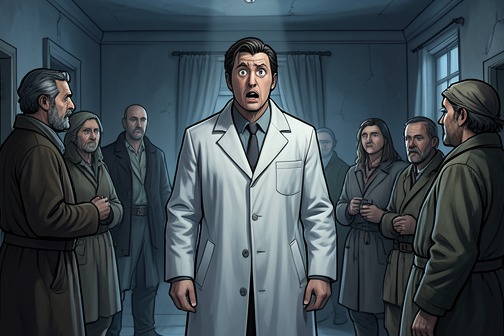
[Robinson’s failed attempt to murder Grandma Henrouille leaves him blind](entity:event-recall-event-1f3bcc92a376) and reverses the roles the plot was meant to impose: the intended victim survives, the hired accomplice is incapacitated, and the household must keep him while hiding its own complicity.
## The Arrangement
The scheme takes shape through a bargain between [Robinson](entity:character-recall-character-robinson-29744adcf921) and the Henrouille couple. When [Ferdinand Bardamu](entity:character-recall-character-ferdinand-bardamu-9de4af40bdf1) recognizes the danger, he asks whether Robinson is really going to murder [Grandma Henrouille](entity:character-recall-character-grandma-henrouille-4862e4914894) merely to please the daughter-in-law. Robinson denies that he is directly committing murder: he says he is building a rabbit hutch, while the fireworks and whatever follows are for the family to handle. His distinction is a self-serving evasion, since he knows what the contraption is meant to do.
Robinson itemizes his payment: a hundred francs for the wood, two hundred and fifty for his labor, and a thousand more for the idea. He imagines that the story, if properly told, could become a pension in itself. The prospective killing is thus at once a paid arrangement and a possible source of continuing income. [Bardamu](entity:character-recall-character-bardamu-9eb69ea71af7) recognizes that argument is unlikely to stop him, and hesitates to tell him that he considers the plan, in its own way, understandable.
The couple and Robinson have worked out the details together. Because Grandma has begun leaving her shack, they intend to send her to feed the rabbits one evening. Fireworks will be fastened to the hutch door and set to explode when she touches it. Her reputation for madness is meant to make the accident seem foreseeable: the neighbors could be told she had been warned not to approach the rabbits and had ignored the warning. The plan depends not only on the device but on a ready-made account that will make the victim appear responsible for her own death.
## The Failure and Its Immediate Consequences
The plan collapses when the rabbit moves as Robinson is fastening the fireworks to the hutch door. The device goes off while he is still connecting it, striking him instead of Grandma. Watching from her shack, she sees the accident unfold; when Bardamu arrives, she is already waiting to accuse the household. Her daughter-in-law summons the doctor, but Grandma confronts him in the hallway and declares that they tried to kill her. The family’s intended explanation has been overturned: the supposed danger to an allegedly unstable old woman has become an injury to the man who was hired to remove her.
Robinson is found upstairs in the couple’s bed, and Grandma makes the blood on the mattress part of her public indictment of the scheme. The daughter-in-law tries to quiet her, chiefly because neighbors might hear. She maintains that she had tried to make Grandma’s life pleasant by urging her to stay with the Sisters, but Grandma insists that this proposed refuge was only another way of sending her away. She names Robinson as the would-be murderer and recounts how she had grown suspicious when she saw him whispering with the couple. Her account turns the household’s secrecy into a spectacle that she controls.
The physical reversal is also a reversal in Grandma’s will to live. The failed attack has nearly killed her, yet she is less subdued than before: the incident revives her, and she savors both her survival and the prospect of tormenting her daughter-in-law with the exposed plot. She insists that she still has both eyes and wants to see her own death, rejecting the assumption that she is already near the end. The scheme designed to make her disappearance look natural instead gives her renewed energy and a powerful position within the household.
For Robinson, the consequences are lasting. The household cannot send him to a hospital without inviting gossip, while returning him to his lodging is considered impossible given his condition. The Henrouilles therefore have to keep him. Bardamu treats the wound, which is jagged and contaminated with dirt, and initially sees no infection; he expects scarring of the corneas that may obstruct light or prevent it from passing at all. The blinds are kept drawn, and the family gives curious neighbors invented explanations, but their concealment only feeds speculation. Robinson fears being expelled or prosecuted, while the people responsible for the failed plot are trapped in the practical and social consequences of having him under their roof.
## Blindness and Its Recognition
At first, Robinson’s prospects remain uncertain. While his eyelids suppurate, Bardamu tries to reassure him with stories about his eyes and what the future may hold, sometimes pretending the window is shut when it is open or that daylight has given way to darkness. The consolation depends on keeping Robinson from testing what he can see. One day, while Bardamu has turned away, Robinson makes his way to the window and removes the bandage. He touches the frame on either side, then realizes that the window is open but sight has not returned. Calling out to Bardamu, he insists that the window is open; with both arms extended into the air, he tries to reach outward through the darkness. Bardamu pushes him back to bed and offers comfort, but Robinson no longer believes him and begins to cry. The attempt to conceal the truth has reached its limit: Robinson discovers his blindness by testing the ordinary boundary of a window, an object that confirms not freedom of movement but the extent of what he can no longer perceive.
## Aftermath and Recognition
After Robinson discovers his blindness, there is no longer a comforting account of what may happen to him. Bardamu has pushed him back from the window and tried to console him, but Robinson no longer believes the reassurances. His discovery leaves him crying and, in Bardamu’s reflection, at the end of what can happen to him: even grief offers no answer, and a person must return among others simply to begin again. The practical burden remains unresolved as well. At lunch, the Henrouilles have no serious plan for getting out of the predicament; the cost of buying Robinson a pension frightens them, and the daughter-in-law has approached Public Welfare without wanting to discuss the steps she has taken.
The episode turns a concealed plan into a household crisis that none of its participants can control. The rabbit hutch and fireworks, intended to make Grandma’s death look like an accident, instead disable Robinson, expose the family’s complicity to their intended victim, and oblige the Henrouilles to shelter the man they hired. Grandma’s survival is more than a reprieve: the attempted murder renews her determination to live and gives her leverage over the daughter-in-law. Robinson’s blindness, meanwhile, is recognized through the simplest test of the outside world—the open window—whose fresh air reaches him while sight does not. Through these reversals, the plot makes an act designed to erase an old woman produce new dependence, scrutiny, and lasting consequences for the would-be accomplice.
Event 21
Robinson and Grandma Henrouille move to Toulouse
[Robinson and Grandma Henrouille move to Toulouse](entity:event-recall-event-a26bee8fc025) through a hurried scheme devised by [Abbé Protiste](entity:character-recall-character-abb-protiste-6b4e89013023) and accepted by [Ferdinand Bardamu](entity:character-recall-character-ferdinand-bardamu-9de4af40bdf1). Intended to remove the pair from the danger and scandal left by the failed attempt on the old woman’s life, the relocation turns them into caretakers of a church crypt and its mummies. In [Toulouse](entity:location-recall-location-ddb428d21325), the dead become a paying attraction, [Grandma Henrouille](entity:character-recall-character-grandma-henrouille-4862e4914894) finds a profitable occupation, and [Robinson](entity:character-recall-character-robinson-29744adcf921)’s damaged eyes begin to improve; the move promises a new life, but its foundation is an improvised bargain in which fear, money, and the handling of the dead are inseparable.
## Causes and Arrangement
Abbé Protiste visits [Bardamu](entity:character-recall-character-bardamu-9eb69ea71af7) to discuss a plan that has been underway with [Madame Henrouille](entity:character-recall-character-madame-henrouille-99b55a9dbd43): finding an inexpensive religious institution for Grandma Henrouille and Robinson together. The priest explains that Madame Henrouille had approached him after the incident, seeking help with the predicament the family had created. His manner suggests embarrassment at his part in the affair, but the scheme proceeds all the same. He and Bardamu are not acting from some untouched position outside the surrounding wrongdoing; as Bardamu puts it, the priest has joined them in the night.
A place among nuns in the provinces might have been possible, but it would take months to find a vacancy. The family is sick of waiting, and the immediate pressure is to get the two out of sight. Protiste therefore proposes a faster alternative: Bardamu is to persuade Robinson to go south, along with Grandma Henrouille. The proposal is explicitly advantageous to the intermediaries as well as the family. Bardamu is promised a commission, and he agrees to keep quiet and help, even while recognizing that the plan is wild and that Robinson has come close to murdering the old woman he is now expected to accompany.
The destination is Toulouse, where Robinson and Grandma Henrouille will have lodgings and work connected with a church crypt. Bardamu promises to visit once they are settled. To win Robinson over, he means to present the South as an excellent climate for damaged eyes and to describe the move as a stroke of luck. His own reasoning shifts with the promised payment: he is troubled by how soon Robinson must leave, but glad that he will at last make a real profit. A thousand francs is offered for his part in arranging the move, and he quickly persuades himself that the scheme is sensible.
The work is a mummy exhibition. The bodies lie in the cellar of a church, where visitors pay to see them; Protiste presents the enterprise as good business. Bardamu is almost persuaded by the priest’s confidence and even admits to a flicker of jealousy at a business that puts the dead to work. The relocation is thus less a rescue into a secure institution than a placement in an unusual commercial arrangement, devised to solve an urgent family problem and to reward those who arrange it.
## Life in the Crypt
When Bardamu eventually sets out to see Robinson and the crypt, the move has already taken effect. At the [Church of Sainte-Eponime](entity:organization-recall-organization-church-of-sainte-1dfefea1f3f8), he learns from the young caretaker that she fills in for Grandma Henrouille at lunchtime and works for a dressmaker in the afternoon. Robinson is doing better: a specialist believes he may soon see well enough to go out alone. Grandma Henrouille, meanwhile, appears delighted with the vault and is making money there. Their lodging is less benign. [Bedbugs](entity:creature-recall-creature-bedbugs-3535bc05b5ef) keep the household awake, especially on stormy nights, and the occupants burn sulfur to deal with them.
The crypt contains twenty-six bodies, preserved after spending more than five hundred years in quicklime. The collection includes two women in bonnets, a hunchback, a giant, and a complete baby with lace around its dried neck and remnants of swaddling clothes. The corpses have passed through decay toward dust, but the display makes their preserved remains available to the living as both spectacle and source of income. Grandma Henrouille has gone from being a vulnerable old woman who herself once looked like one of the mummies to earning money by exhibiting them.
During the height of the summer season, Grandma Henrouille is present whenever a party of tourists arrives. She makes the mummies perform for the visitors and brings in a hundred francs a day. Her sales talk turns the remains into a guided attraction: she explains the quicklime preservation, points out the surviving skin and clothing, and emphasizes that the bodies are not indecent. Visitors are told that the baby was buried with its mother and that a tall man still has all his teeth. At the end of the tour, she taps the dried bodies so that they sound like drums, and invites visitors to touch them while warning them not to pull too hard because they are fragile.
Robinson’s part in the business is more limited. The stairs down to the cellar are treacherously narrow, and he does not often descend. Most of the time he stands at the entrance, gives tourists a little sales talk, and gets used to taking in a few specks of light. The division of labor places Grandma Henrouille among the mummies and Robinson at the threshold: she handles the exhibition directly, while he remains close to the entrance as his sight slowly improves.
## Robinson’s Recovery and New Prospects
The move gives Robinson a change in circumstances, but not a clean restoration. When Protiste returns to Bardamu with news, he reports that Robinson’s eyes are considerably better and that the inflammation of his lids has stopped. By the time Bardamu visits Toulouse, a specialist expects that Robinson will soon be able to go out by himself. This is a concrete improvement in the condition that helped make him an object of the family’s plans, though Robinson’s recovery remains partial and dependent on the specialist’s assessment.
A marriage is also being arranged. Protiste tells Bardamu that Robinson is about to marry the daughter of the woman who sells candles in the church beside the burial vault. The caretaker introduces herself as [Madelon](entity:character-recall-character-madelon-0f7f5c8d79c0). She is about twenty, works part-time in the crypt and for a dressmaker, and confirms that Robinson is improving. She is set on the projected marriage, while Bardamu privately doubts that she understands the extent of Robinson’s injuries: in his view, the damage reaches beyond his eyes to his nerves and morale. He does not warn her, and the conversation turns instead to the crypt and its occupants.
The caretaker says that Robinson speaks pleasantly of Bardamu. When Bardamu visits, he and Madelon talk about Robinson’s plans and the stories he has told her about America and the tropics. Bardamu has traveled with Robinson and has stories of his own, so he offers to tell her some. Their conversation carries them into an intimate encounter in the crypt, interrupted by the prospect of Grandma Henrouille returning from lunch. They climb back toward daylight by the steep, rickety staircase, which Bardamu notes. Robinson’s proposed marriage and Bardamu’s closeness with Madelon therefore emerge during the very visit meant to confirm that the relocation has settled his friend into a new life.
## Profit, Spectacle, and the Dead
The financial terms of the move recur as the arrangement develops. When Protiste later visits Bardamu to divide the commission from the crypt, each receives fifteen hundred francs. Bardamu had expected the priest’s arrival less and treats his appearance as a welcome gift. The payment makes him indulgent and optimistic about Robinson’s plans. The increased sum also confirms that the relocation has not been a disinterested act of charity: Bardamu’s involvement brings him a continuing share in a business built around the crypt.
The enterprise makes the boundary between care and exploitation difficult to separate. Grandma Henrouille has a place to live and work, and Robinson’s eyes improve; at the same time, the scheme has been arranged in haste to remove them from a dangerous family situation, and Bardamu receives money for persuading his friend to accept it. The business also depends on presenting the dead as harmless and contented objects of curiosity. Madelon asks whether they look sad, but Bardamu observes that they cannot speak for themselves and that the claim that the dead are happy proves nothing. Grandma Henrouille’s performance is more openly physical: when enough dried skin remains, she clouts a mummy’s belly to make it go boom.
The Toulouse move therefore resolves one immediate crisis without escaping the conditions that produced it. A family’s fear of scandal becomes a church business; the old woman’s need for shelter becomes paid work among bodies; Robinson’s impaired sight becomes a sales pitch for the southern climate and, later, a practical limit on how far down the cellar stairs he can go. The crypt offers a livelihood and a prospect of marriage, but its carefully rehearsed talk and fee-paying visitors make the new beginning inseparable from the spectacle of death.
Event 22
Monsieur Henrouille’s death
[Monsieur Henrouille’s death](entity:event-recall-event-93fbef433fc2) turns a doctor’s uneasy return to a familiar household into a confrontation with bodily decline, family suspicion, and the small possessions that outlast their owners. Summoned to the Henrouille home after two months of worsening illness, [Ferdinand Bardamu](entity:character-recall-character-ferdinand-bardamu-9de4af40bdf1) recognizes that the heart is failing and anticipates a public autopsy amid neighborhood rumors. The man dies without explaining the family’s earlier affair or the fate of his mother; afterward, a gold dental plate becomes the immediate cause of [Bardamu](entity:character-recall-character-bardamu-9eb69ea71af7)’s final break with the widow.
## Background and Return to the Henrouille Home
Bardamu’s visit begins in apprehension. He has been wondering what is happening in [Toulouse](entity:location-recall-location-ddb428d21325) and considers returning to the Henrouilles for information, but he knows that going back to certain people can draw him into danger. Roaming near their house, he hesitates in the rain rather than approach. The daughter-in-law sees him from across the street, opens the door just enough to beckon him in, and calls him by name. Her invitation turns his reluctant visit into an urgent medical summons.
Inside, the familiar corridor and its stove revive Bardamu’s unease. The daughter-in-law says that her husband has been ill for two months and is steadily deteriorating. Asked about the family’s affairs in Toulouse, she first evades the question, then quickly assures him that both are fine and their business is going well. She immediately returns to her husband’s condition, insisting that he needs Bardamu at once, trusts no other doctor, and has refused to see anyone else. Bardamu recognizes the claims as a pretext, but curiosity and his knowledge of the household lead him upstairs.
## The Failing Heart
[Monsieur Henrouille](entity:character-recall-character-monsieur-henrouille-766089ad3405) lies in the same bed where Bardamu had treated [Robinson](entity:character-recall-character-robinson-29744adcf921) after an accident months earlier. The room is physically unchanged, yet Bardamu experiences it as altered by time: its old objects seem more deeply marked by age and by the approach of death. This return makes the domestic setting feel less like a stable backdrop than a place where familiar things have quietly accumulated mortality.
Left alone with his patient, Bardamu finds him in grave condition. His circulation is failing, and the trouble lies in his heart. Monsieur Henrouille states plainly that he is going to die. Bardamu listens to the racing heartbeat and performs the gestures expected of a doctor, while judging that the heart cannot recover. His clinical attention is inseparable from a grotesque anticipation of what comes next: he imagines the heart exposed at an autopsy and expects the death to look suspicious after the household’s previous affair.
The patient’s suffering is not presented as a clean passage from life to death. He seems already partly gone, yet cannot stop breathing; air leaves his lungs and returns, and each breath prolongs the struggle. He says that he can no longer feel his feet and is cold up to his knees, trying unsuccessfully to touch them. He cannot drink. His wife has prepared tisane, and Bardamu wonders whether anything has been put into it, though he admits that its unpleasant smell proves nothing. The possibility of poison remains a suspicion, not a finding: the patient is so close to death that Bardamu doubts the drink could alter the outcome.
## The Dental Plate and the Last Conversation
The wife listens behind the door while Bardamu consults with her husband. When Bardamu catches her eavesdropping, she whispers to him. He suggests that Monsieur Henrouille be allowed to keep his dental plate in place; the wife says she could never forgive herself if she did. Back in the room, Bardamu finds the patient pleased to have him return. Between suffocating spells, Monsieur Henrouille asks how Bardamu is doing and whether he has built up a new practice. Bardamu gives reassuring answers rather than explain the complications of his life.
The wife signals from behind the door that Bardamu should tell her husband to remove the plate. He whispers the advice, and Monsieur Henrouille replies that he has thrown it down the toilet, looking more frightened than before. Bardamu reads the act as an expression of vanity: throughout his life, the dying man had taken aesthetic care with his dental plate. The episode sharply narrows the scene’s emotional focus. As death approaches, an expensive object associated with appearance and self-regard becomes the subject that can still provoke a decisive reaction.
Bardamu hopes the dying man might use the moment to speak about his mother and what had been done to her, but Monsieur Henrouille’s mind wanders. He begins to drool, and no further confession can be drawn from him. Bardamu wipes his lips and goes downstairs. The wife is angry about the missing plate and blames Bardamu, stressing that it was gold and that she knows what her husband paid for it. Bardamu offers to try speaking with him again, but only if she accompanies him. On their return, the patient barely recognizes them. His breathing is quieter while the two speak together, as though he wants to hear what they say.
## [Death](entity:concept-recall-concept-death-17a4b4500b5e) and Aftermath
The scene leaves the earlier family history unresolved. The neighbors, already burdened with suspicions arising from the previous affair, are waiting to scrutinize the wife, and Bardamu expects rumors to intensify after the death. He foresees a court-ordered autopsy, which would expose the body and give the neighborhood’s talk a public occasion. Yet that anticipated inquiry never happens. Bardamu does not attend the funeral, and the autopsy is quietly avoided.
The only definite rupture after Monsieur Henrouille’s death concerns the dental plate: Bardamu and the widow are permanently on bad terms because of it. The small domestic dispute replaces the public reckoning he had imagined. His suspicions about the illness and the household remain suspicions; the dying man’s unspoken history remains unspoken. The episode’s bleakness lies partly in this mismatch between the magnitude of death and the narrow, material quarrel that survives it. The heart fails, the possible confession disappears, and the plate—not an autopsy or an answer—determines the final shape of Bardamu’s relationship with the widow.
## Narrative Significance
Bardamu narrates the episode retrospectively in the first person, shifting between the immediate details of the sickroom and reflections on what returning to old places does to perception. His account lingers on ordinary objects and bodily signs—the stove, the bed, the dental plate, the failing circulation, the lost feeling in the feet—so that death appears not as an abstract conclusion but as a physical and domestic process. The same room that once held Robinson after an accident now holds another man nearing death; unchanged surroundings become newly charged by the time that has passed.
The dental plate also gives the episode its bitterly concrete counterpoint to the larger questions Bardamu cannot settle. He suspects the wife, imagines an autopsy, and hopes for an account of the family’s past, but none of these possibilities becomes proof or revelation. Instead, the patient’s final act concerns the object he has valued for its appearance, and the survivors quarrel over its gold. Death closes off the testimony Bardamu wants; what remains is not explanation but a broken relationship, shaped by a possession that has outlasted its owner.
Event 23
Robinson and Madelon’s engagement arrangement

[Robinson and Madelon’s engagement arrangement](entity:event-recall-event-7ffb1f067373) develops in [Toulouse](entity:location-recall-location-ddb428d21325) as a precarious bargain among marriage, money, illness, and the business of displaying the dead. [Robinson](entity:character-recall-character-robinson-29744adcf921), recovering some sight, expects to marry [Madelon](entity:character-recall-character-madelon-0f7f5c8d79c0) and build a life with her; [Ferdinand](entity:character-recall-character-ferdinand-e88c57ad784c), who helps facilitate the move and later becomes Madelon’s lover, sees both the promise and the self-deception in those plans. What appears to be a route toward settled domestic life is shadowed from the outset by commercial calculation and divided loyalties.
## Background: A Church Crypt and a Commission
The prospect of marriage emerges after [Abbé Protiste](entity:character-recall-character-abb-protiste-6b4e89013023) tells Ferdinand that Robinson’s eyes are improving and that Robinson is expected to marry the daughter of the woman who sells candles at the church beside [Grandma Henrouille](entity:character-recall-character-grandma-henrouille-4862e4914894)’s burial vault. Ferdinand has helped arrange Robinson and the old woman’s relocation to Toulouse, where Grandma Henrouille’s crypt is turned into a paying attraction. When Protiste visits Ferdinand, he brings him a share of the commission: fifteen hundred francs each. The money makes Ferdinand more indulgent toward the plan, and the news about Robinson’s future strikes him as sensible under the circumstances.
The marriage arrangement is thus linked to the same economy as the relocation. Grandma Henrouille earns money by showing tourists the mummies, and the proposed move offers Robinson a place in that scheme as well as a chance at marriage. Ferdinand even thinks of the dead as being made to work for the living. The engagement is not simply a romantic development: it takes shape inside a practical arrangement involving a church, a crypt, paying visitors, and a commission that benefits Ferdinand and Protiste.
## Madelon and the Prospective Match
Ferdinand first learns the young woman’s name while visiting the crypt: Madelon. She tells him that she covers for Grandma Henrouille during the lunch hour and works afternoons for a dressmaker on Rue du Theatre. She reassures him that Robinson is doing much better; a specialist thinks he will soon see well enough to go out alone. Grandma Henrouille, meanwhile, is pleased with the vault and is saving money from the business. The chief domestic nuisance is the bedbugs in the house, which keep the residents awake, particularly on stormy nights, and are treated with burning sulfur.
Madelon’s account makes the future marriage sound feasible. Robinson is recovering, and Madelon appears committed to the projected match. Ferdinand, however, believes Robinson will remain an invalid even if his eyesight improves, because his nerves and morale are also damaged. He nearly warns Madelon, but cannot steer the conversation through the subject of marriage. Instead, he asks to see the cellar. The engagement therefore becomes visible beside the mummies that help finance the household: a future being planned amid bodily vulnerability, cramped living conditions, and a business built around death.
## The Crypt and the Business of [Death](entity:concept-recall-concept-death-17a4b4500b5e)
Madelon leads Ferdinand through the cellar by lantern light. The display contains twenty-six bodies, including two women wearing bonnets, a hunchback, a giant, and a baby in remnants of lace and swaddling clothes. They have spent more than five hundred years in a quicklime cemetery, and time has reduced their bodies to damaged remnants. Their condition gives physical substance to the business supporting Grandma Henrouille and the household in which Robinson and Madelon expect to marry.
During the height of summer, Grandma Henrouille makes as much as a hundred francs a day when tourists arrive. She presents the corpses as an attraction, even striking one on the belly when enough dried skin remains to make a hollow sound. Madelon asks whether they look sad, but Ferdinand reflects that the dead cannot speak for themselves and that a performance of cheerfulness proves nothing. The crypt is at once a source of income and a setting that unsettles the marriage’s hopeful surface: the couple’s projected future is being formed in the shadow of bodies whose long decay has become a livelihood.
## Ferdinand’s Affair and Robinson’s Plans
After Robinson settles in the South, Madelon and Ferdinand begin meeting in private. Their encounters are brief and difficult to arrange; they do not speak of them. Ferdinand is jealous as Robinson grows more attached to Madelon, but he distinguishes his own concealed relationship from Robinson’s engagement. Madelon can love Robinson while meeting Ferdinand, he reasons, because Robinson is only playing at being engaged and she is correspondingly playing at being faithful. Robinson, for his part, says he will not touch her before marriage. The engagement’s appearance of mutual fidelity coexists with Ferdinand’s affair and with the different expectations each man assigns to the future.
Robinson imagines a practical escape from dependence on Grandma Henrouille. He intends to marry Madelon, open a small restaurant with her, and leave the old woman behind; he hopes to obtain some starting capital from Grandma Henrouille. He praises Madelon’s cooking and expects customers to like her. His plans combine affection with calculation, but they also rest on confidence Ferdinand regards as misplaced. Ferdinand has already judged Robinson to be increasingly absorbed by money and domestic respectability, and he suspects Grandma Henrouille will not readily provide the capital.
Ferdinand’s assessment of Robinson is conflicted rather than detached. He calls him a bourgeois, condemns his preoccupation with money, and thinks he has been changed by Grandma Henrouille’s saving habits and Madelon’s wish to marry. Yet he admits to jealousy and acknowledges his own involvement with Madelon. Robinson’s improving sight makes the proposed life seem more attainable, but Ferdinand sees a more complicated recovery: the eyes may improve while Robinson’s lungs, nerves, and morale remain damaged. The engagement arrangement thus holds out stability without resolving either Robinson’s illness or the unequal, competing desires within the relationship.
Event 24
Grandma Henrouille’s death in the crypt
[Grandma Henrouille’s death in the crypt](entity:event-recall-event-grandma-henrouille-s-de-771a6aaedbf4) is disclosed as a calculated killing made to look accidental, a revelation that turns the family’s cramped, unstable surroundings into cover for [Robinson](entity:character-recall-character-robinson-29744adcf921)’s crime. [Ferdinand](entity:character-recall-character-ferdinand-e88c57ad784c) first hears of the death from [Abbé Protiste](entity:character-recall-character-abb-protiste-6b4e89013023) in [Toulouse](entity:location-recall-location-ddb428d21325), then privately gets Robinson to reconstruct what happened. The two tellings converge on the same fact: Robinson pushed the old woman down the cellar stairs, and the belief that he was still blind shielded him from suspicion.
## The [Death](entity:concept-recall-concept-death-17a4b4500b5e) Reported in Toulouse
Ferdinand learns of the death during a conversation with Abbé Protiste, who has arrived from Toulouse. The report is not delivered as a straightforward confession. Ferdinand pretends to be astonished and asks when the old woman died; Protiste gradually has to disclose more. He never says outright who pushed her, but he gives Ferdinand enough to infer the answer. The indirectness makes the news a test of what Ferdinand already knows as much as an account of the death itself.
Protiste’s account also fixes the public version of events. The neighborhood takes the death for a tragic accident, judged plausible in light of [Grandma Henrouille](entity:character-recall-character-grandma-henrouille-4862e4914894)’s age, the late-afternoon hour, and her presumed tiredness. Most importantly, people believe Robinson is still completely blind. That assumption makes an intentional push seem unlikely to them and allows the accident explanation to stand.
## Robinson’s Account of the Killing
Ferdinand later speaks with Robinson in an isolation room at the institution. He has already heard Protiste’s hints and knows Robinson is capable of another attempt; he now invites him to explain the whole scheme. Robinson admits that the old woman had become a persistent source of resentment. As his eyesight improved and he could go out alone, he began to see her again; he describes her presence in the house as constant and oppressive. The household’s small size, with everyone crowded together, supplies the immediate setting for their conflict, but Robinson’s account makes clear that the death was not simply an accident born of that tension.
Ferdinand asks about the cellar stairs, which he had noticed were shaky when he first visited the crypt with [Madelon](entity:character-recall-character-madelon-0f7f5c8d79c0). Robinson agrees that their weakness made the setting practically a setup. He acknowledges that he pushed Grandma Henrouille down them, describing this as his successful second attempt. The compromised stairs helped make the act appear accidental, while his improved but still concealed vision let him act without the neighbors recognizing him as capable of it.
## Concealment and the Misreading of Robinson
The murder’s concealment depends on the gap between Robinson’s actual condition and the neighborhood’s belief. Although his eyes had begun to improve enough for him to go out alone and see Grandma Henrouille, the people around him continued to regard him as blind and therefore incapable of the crime. They consequently interpreted the death through familiar circumstances—an elderly woman, a dangerous staircase, and the time of day—rather than suspecting a deliberate act.
Ferdinand and Robinson’s later conversation gives the earlier report a more definite meaning. Protiste had allowed Ferdinand to guess without naming the killer; Robinson’s admission confirms that inference. The scene is thus structured as a staged disclosure: first the death is explained away publicly, then its circumstances are pieced together privately, and finally Robinson supplies the direct acknowledgment that the earlier account withheld.
## Narrative Significance
The death turns an apparently ordinary domestic accident into a concealed act of violence. A defective staircase and a shared, crowded house are not incidental background: they provide the conditions under which Robinson can make murder pass for misfortune. The same details that make an accident believable also help expose how easily a community’s assumptions can substitute for investigation.
The revelation is delivered through two conversations rather than through an eyewitness account of the killing. Protiste’s cautious hints invite Ferdinand’s inference; Robinson’s later admission completes it. This delayed confirmation makes the reader follow the same progression from an ambiguous death report to a private explanation, while the gap between Robinson’s improving sight and the neighborhood’s assumption of blindness supplies the decisive concealment. The outcome is not a mystery left unresolved: Robinson’s account identifies him as the person who pushed Grandma Henrouille down the stairs and explains why the act was taken for an accident.
Event 25
Baryton’s departure from the asylum
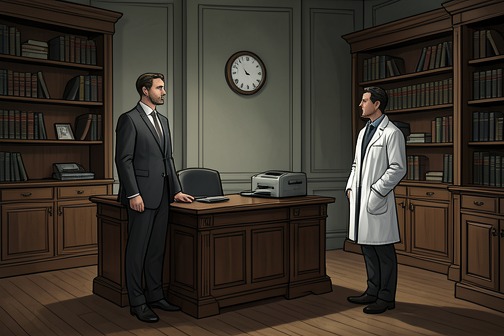
[Baryton’s departure from the asylum](entity:event-recall-event-e15db6ac2fb2) is a rupture in the life of an institution built around his long, methodical authority. A passage from Macaulay’s History of [England](entity:location-recall-location-edbf4fdebc64) brings his dissatisfaction with that life to a crisis; he resolves to leave for England, appoints [Ferdinand Bardamu](entity:character-recall-character-ferdinand-bardamu-9de4af40bdf1) to manage the asylum in his absence, and entrusts its practical and laboratory work to [Serge Parapine](entity:character-recall-character-serge-parapine-ed785f0bf934). His departure is at once an escape he insists is final and a transfer of responsibility whose consequences fall on those he leaves behind.
## Background and Turning Point
For more than thirty years, Baryton had made the asylum his life’s work, tending its administration with an intensity that had once seemed inseparable from his identity. By the time of his departure, however, he had withdrawn from its daily affairs and relied on [Parapine](entity:character-recall-character-parapine-7ef0d2304db4) to manage them. His growing inward confusion was visible even as he tried to conceal it in public, and he had become increasingly reluctant to be disturbed.
The immediate turning point comes through a reading assignment. At the start of their studies, Baryton and [Bardamu](entity:character-recall-character-bardamu-9eb69ea71af7) had read Macaulay’s sixteen-volume History of England too quickly for Baryton’s satisfaction. Baryton orders them back to it, chapter by chapter. When they reach the passage about Monmouth’s failed venture—his uncertainty about what he is doing and his desire to escape—Baryton reads and rereads it, closes the book, and recites the passage from memory. The episode gives his own hesitation a literary counterpart: the text does not merely occupy him but seems to expose the uncertainty already gathering around his decisions.
Baryton is seized with vertigo by what he sees in Monmouth’s predicament: the absurdity and tragedy of human nature. The narrator presents the moment as a break in continuity. Until then, only a tenuous thread had connected Baryton to the common life around him; now, Bardamu says, that thread snaps. Baryton has not yet explained his destination, but the reading scene prepares the departure as more than a change of residence: it is his rejection of the life and work that had held him in place.
## Baryton Announces His Departure
Late that night, Baryton summons Bardamu to his office. Bardamu expects a major decision affecting his employment, such as dismissal, but learns instead that Baryton intends to leave. He describes himself as someone of settled habits, near old age, whose career had been devoted to patient and scrupulous work. Yet he says that, within a few months, he has turned away from all of it and feels detached and exhilarated by the prospect of beginning again. His past, he declares, has ceased to exist; he is going away, fleeing, escaping.
Bardamu tries to soften the decision by suggesting that the journey might be a temporary holiday, a welcome interval after which Baryton could return refreshed to his post. The attempt briefly touches Baryton’s pride, but it does not change his resolve. Baryton says that forty years of prudent smallness have left him drained, stultified, and defeated. What he wants, he explains, is to get away from the burden of his former self, to be alone and at peace. His language gives the departure its central contradiction: he seeks freedom by breaking with the accumulated identity and obligations that have defined him, not by reforming his familiar life.
The institution’s future makes the break concrete. When Bardamu asks what will happen to it, Baryton appoints him director for the duration of his absence. The clientele, he expects, will accept Bardamu; Parapine will handle the machinery and laboratory. Baryton adds that he no longer believes anyone’s presence is indispensable, a marked change from the earlier investment that made the asylum his life’s work. His confidence in the practical arrangement does not erase the upheaval: the people left behind must keep the establishment running while its founder abandons it.
## Arrangements and Farewell
Baryton has considered the professional and personal repercussions. He is troubled by how competing practitioners in nearby places might interpret his voluntary exile, and by the difficulties his daughter Aimée may face. He is leaving her in the care of an aunt in the provinces, whom he regards as a stranger. Once his private affairs are settled, Bardamu and Parapine will be responsible for looking after his interests and property as best they can. The departure therefore involves not only the institution but a redistribution of practical duties and care.
Asked where he is going, Baryton answers that he is bound for England. The next day, Bardamu and Parapine help him with his luggage. His unfamiliarity with travel procedures is apparent when the passport’s pages and visas surprise him and he asks whether he can obtain several spare passports. Near departure, he is still uncertain whether to take hard or soft collars, and how many of each. These decisions nearly carry the three men to the time of the train.
Baryton takes only a small suitcase, intending to travel light and remain mobile. On the platform, he hesitates before the high steps of the international train; Bardamu and Parapine help him aboard. He has a second-class ticket and remarks, “First is no better,” a practical observation that briefly restores his familiar manner. They shake hands. The whistle sounds, the train pulls out with a jolt, and the noise cuts across their farewells. Baryton has time to say, “Good-bye, boys!” before his hand slips from theirs and becomes a diminishing figure in the smoke and darkness.
## Aftermath and Significance
The narrator admits that they are, in one sense, not sorry to see Baryton go, yet the house feels empty without him. His manner of leaving makes them sad despite themselves; the departure feels unnatural, and they are left wondering what will happen to them. The mixed response captures the cost of a break that is at once desired by Baryton and destabilizing to the people and institution he abandons.
The episode’s movement from a familiar reading routine to a sudden break, then from a declaration of escape to the small logistics of collars, passports, tickets, and handshakes, holds Baryton’s grand resolution against ordinary practical life. His departure is not presented as a completed renewal: the evidence establishes his intention and destination, but not what he will find in England or whether he will return. What it does establish is that the asylum’s founder has withdrawn his claim to indispensability, leaving Bardamu and Parapine to sustain the institution after the authority around which it had been organized has gone.
Event 26
Robinson’s flight from Toulouse
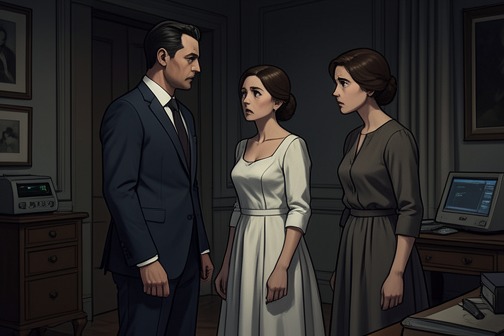
[Robinson’s flight from Toulouse](entity:event-recall-event-f449b9324a07) is a remembered escape from the life he has acquired there: a comfortable situation, the prospect of marriage to [Madelon](entity:character-recall-character-madelon-0f7f5c8d79c0), and a place alongside her mother’s crypt business. He wants to leave them and travel alone, but his attempts to end the relationship only intensify Madelon’s devotion. The episode closes not with an agreement or reconciliation but with [Robinson](entity:character-recall-character-robinson-29744adcf921) quietly leaving while the two women are away, and with [Ferdinand Bardamu](entity:character-recall-character-ferdinand-bardamu-9de4af40bdf1) listening at a distance that marks his own growing indifference.
## Background and the desire to leave
Robinson’s departure begins as a wish to abandon [Toulouse](entity:location-recall-location-ddb428d21325) and the domestic future others have arranged around him. By the time [Abbé Protiste](entity:character-recall-character-abb-protiste-6b4e89013023) visits [Ferdinand](entity:character-recall-character-ferdinand-e88c57ad784c), Robinson has regained his eyesight and appears to enjoy material comfort, with a happy marriage seemingly ahead. Protiste reports that he has nevertheless disappointed the hopes invested in him and is again yielding to an impulse to escape. His fiancée and her mother, initially angry, have become grief-stricken; Protiste approaches Ferdinand hoping to draw out an opinion about Robinson’s tendency to run away.
Ferdinand recognizes the family matter as dangerous ground. He decides to say nothing and avoid involvement, then returns to the rest home after an unsuccessful, coolly ended conversation with Protiste at a streetcar stop. The framing matters: Robinson’s flight reaches the reader first as secondhand news, filtered through a priest who is seeking Ferdinand’s response. Only later does Robinson give Ferdinand his own account, converting an apparent pattern of escapades into a detailed story of pursuit, resistance, and departure.
## A relationship that tightens under pressure
In Robinson’s telling, Madelon’s mother repeatedly denounces his character precisely when he needs kindness. He says the mother’s hostility makes it impossible for the arrangement to continue, and that he therefore proposes leaving her and Madelon in charge of the crypt while he travels alone for a time. Madelon rejects the separation. She invokes their engagement and insists that she must go with him, adding that he is not well enough to travel alone. Robinson answers that he is well and intends to go by himself, but the disagreement does not settle the matter.
The conflict continues for weeks. After an argument, Robinson goes out for a walk because they have said too much and cannot safely remain in the same room. Even so, he and the women keep wrangling and watching one another, especially at night. They cannot bring themselves to break up, but the relationship has lost its emotional conviction; as Robinson describes it, fear, rather than love, is what keeps them together. Madelon’s suspicion that he loves someone else gives their stalemate a personal accusation, while Robinson presents the underlying issue as his wish to escape their shared life.
Madelon changes her strategy when shame and reproach fail to hold him. She insists that she wants him, not the crypt or its business, and pleads that people who have loved each other should not separate. She offers to put her mother in charge of the crypt if she and Robinson can go together to [Paris](entity:location-recall-location-paris-c02b439ce220) to look for work. Her proposal accepts a major change in their circumstances, but not the one Robinson seeks: she will tolerate almost anything except going their separate ways. Her determined pursuit becomes, in his account, the very pressure that makes him increasingly sick of the whole arrangement.
## Feigned madness and the failed escape plan
Unable to persuade Madelon through ordinary argument, Robinson tries to make himself impossible to remain with. He tells her that he sometimes loses his mind and has fits without warning. The claim is calculated: he hopes that his war experiences, his actions involving [Grandma Henrouille](entity:character-recall-character-grandma-henrouille-4862e4914894), and his strange behavior will make the story plausible enough to frighten her away. For more than a week, Madelon leaves him alone, and Robinson believes she and her mother may no longer be so eager to keep him. He imagines he can slip off quietly toward Paris without a scene.
Robinson then overplays the deception. To prove that his fits are genuine, he asks Madelon to feel the bump on the back of his head and the scar on top of it. He says that the wound came from [Flanders](entity:location-recall-location-3ff0009360ef), where he had been trepanned. Instead of recoiling, Madelon responds with intensified affection. Touching the scar makes her recognize, or believe she recognizes, the reality of his suffering; she asks his forgiveness for having doubted him. The bodily mark intended as evidence of instability becomes a new bond between them.
After this encounter, Madelon’s mother is no longer allowed to bawl Robinson out. Madelon intervenes on his behalf and protects him, behaving with an intensity that Robinson finds unmistakable. His stratagem has therefore reversed its intended effect: what was meant to break her attachment gives her another reason to defend and keep him. The episode’s dark comedy lies in the mismatch between Robinson’s calculated performance and Madelon’s response. Even the sign he offers as proof that he should be left alone becomes, for her, proof of a claim on his care.
## The quiet departure and its frame
Robinson says he would have preferred to part as friends, but that the effort had become futile. One morning, while Madelon and her mother are out shopping, he packs a small bundle and leaves quietly. He insists to Ferdinand that he has tried everything and asks him not to dismiss his fear that Madelon may come looking for him. His proposed protection is to be locked up with the mentally ill, where he could pretend not to understand her; he believes that pretending ignorance is the only way to deal with her. The escape is thus both a physical departure and a plan to evade the relationship through concealment.
Ferdinand does not meet Robinson’s account with the urgency it might once have stirred in him. He reflects that, only a few months earlier, he would have been interested, but that he seems suddenly to have aged. He recognizes in himself a growing resemblance to Baryton and cannot make himself treat Robinson’s situation as a real danger. The story ends by shifting emphasis from Robinson’s fear to Ferdinand’s emotional distance: the listener’s diminished investment is itself a change in the frame through which the escape is received.
## Narrative significance
The episode binds flight to repetition. Robinson once more attempts to leave a situation that has become intolerable, but the means he chooses—first persuasion, then a fabricated account of madness, then the display of his scar—keep him entangled until he can simply disappear. His escape succeeds in the immediate sense: he gets away while his companions are absent. Yet he leaves with the expectation that Madelon may pursue him, and imagines that even confinement might be preferable to facing her directly. Departure offers distance, not resolution.
The relationship’s central contrast is between Madelon’s insistence on togetherness and Robinson’s insistence on being alone. Neither a promise of shared work in Paris nor her renewed tenderness after seeing his wound can reconcile those aims. Ferdinand’s framing adds a further reversal: a story that might once have commanded his concern now has a musty, unreal quality to him. The episode therefore records not only Robinson’s flight from Toulouse but also the listener’s withdrawal from other people’s crises, as the act of telling fails to restore the urgency that the story once might have carried.